Rezi lifetime alternative
Rezi lifetime alternative: what one-time payment really buys
Rezi's lifetime plan is a fair deal on paper, but "lifetime" is doing a lot of quiet work, and your resume still lives in its cloud. Here is an honest comparison with one-time-payment alternatives, with real prices, the data question, and how to choose.
Most people who search for a Rezi lifetime alternative are not unhappy with Rezi. They are standing at the checkout, looking at a 149 dollar one-time price, and doing the sensible thing: checking whether there is a cheaper or a smarter way to pay once for a resume tool before they hand over the money.
That is a good instinct, and this article is here to help with it honestly. Rezi's lifetime plan is a real deal, not a trap, and on the money alone it beats paying monthly for anyone who job-hunts more than once. But the word "lifetime" carries two assumptions worth checking before you buy, and there is a whole category of one-time alternatives that solves a problem Rezi's lifetime plan does not touch. Here is the full picture, with real numbers.
What Rezi's lifetime plan actually is
Rezi is a web-based AI resume builder. You create an account, build a resume in the browser, and it scores your draft against a job description and helps you write bullet points. It is a capable tool with a clean pricing structure, which is part of why people compare against it.
As published in mid-2026, Rezi sells three consumer tiers (Rezi pricing):
- Free. One resume, three PDF downloads, limited AI. No card required.
- Pro. 29 US dollars a month, or 57 dollars every three months. Unlimited resumes and downloads, the full AI toolset, and one expert human resume review included each month.
- Lifetime. 149 US dollars, paid once. All of Pro's building features, permanently.
The lifetime maths is genuinely good. At 149 dollars once versus 29 a month, the lifetime plan pays for itself in just over five months of what Pro would cost, and Rezi backs paid plans with a 30-day money-back guarantee. If you expect to update your resume across several job searches over the years, paying once instead of renting monthly is the better call. On that narrow question, Rezi lifetime wins, and any honest comparison has to say so.
There is one asterisk. The lifetime plan does not include the monthly expert review that Pro comes with. If you want a human to look over a draft, those are sold separately from about 8 dollars each. Small thing, but worth knowing before you assume lifetime equals everything.
Three things "lifetime" is quietly doing
"Lifetime" is a reassuring word on a pricing page. Before you pay for it, it helps to know exactly what it promises and what it does not.
First, it is the product's lifetime, not yours. A lifetime licence lasts as long as the company keeps running the product in its current form. That is normal and not sinister, but it is not the same as a guarantee that stretches across your whole career. Companies get acquired, change direction, or retire old plans. If that happens, "lifetime" ends with the product, and a pre-paid lifetime plan is harder to get a refund on than last month's subscription charge. It is a bet that the tool will still be here, and roughly the same, years from now.
Second, lifetime access is not the same as owning your data. This is the big one. Rezi lifetime buys you permanent access to a cloud tool. Your resume still lives on Rezi's servers, tied to your account, next to your name, address, phone number and full work history. You have paid once for the software, but you have not brought your document home. The pricing model and the privacy model are two separate questions, and paying a one-time fee answers only the first.
Third, "all features" has an edge. As above, the expert reviews that Pro bundles are not part of lifetime. Read the current feature list at checkout rather than assuming the one-time price covers every line item the monthly plan does.
None of this makes Rezi lifetime a bad choice. It makes it a specific choice: a fair one-time price for continued access to a cloud resume builder. Whether that is the alternative you actually want depends on the second question, the one about where your data sits.
Rezi lifetime vs the one-time alternatives, side by side
There are two kinds of "one-time alternative" to Rezi's lifetime plan. One is another cloud builder with a cheaper lifetime or one-off price. The other is a different category entirely: a local tool that charges once and keeps your files on your own machine instead of in an account. The table below uses CVumi as the worked example of the second kind, because it is the tool we make and know in detail. Prices are as published in mid-2026, in their original currencies.
| Rezi Pro (monthly) | Rezi Lifetime | Local one-time tool (CVumi) | |
|---|---|---|---|
| What it is | Cloud web app | Cloud web app | Desktop app for Windows and macOS |
| Price, mid-2026 | 29 USD/month | 149 USD once | 69 EUR once, or 34 EUR with a student email |
| Real first-year cost | About 348 USD | 149 USD, then nothing | 69 EUR, then nothing |
| Billing | Monthly, ongoing | Paid once | Paid once |
| Where your resume lives | Rezi's cloud, tied to an account | Rezi's cloud, tied to an account | A folder you choose on your own computer |
| Account holds your documents | Yes | Yes | No |
| How the AI is paid for | Bundled into the fee | Bundled into the fee | Your own AI provider key, usually a few cents per document |
| Expert human review | 1 per month included | Not included, from about 8 USD each | Not offered; the app runs a fit analysis instead |
| CV, cover letter and email in one pass | Resume help, not all three together | Resume help, not all three together | Yes, generated together for each job |
| What the "once" covers | Nothing, it renews | Access while the product exists | The app and your files, on your device |
Two honest notes on that table. Rezi does things a local tailoring tool does not try to do, including a large template gallery you can browse in any browser and that bundled human review on Pro. And "local" is not "offline": a desktop tool keeps your files on your device, but an AI step still sends that one request to a provider over the internet. The difference is that nothing is parked on the tool maker's server in between.
What it costs over three years
A job search is rarely one month, and most people come back to the same tool for the next move. Three years is a fair horizon. Here the shape of each model becomes obvious.
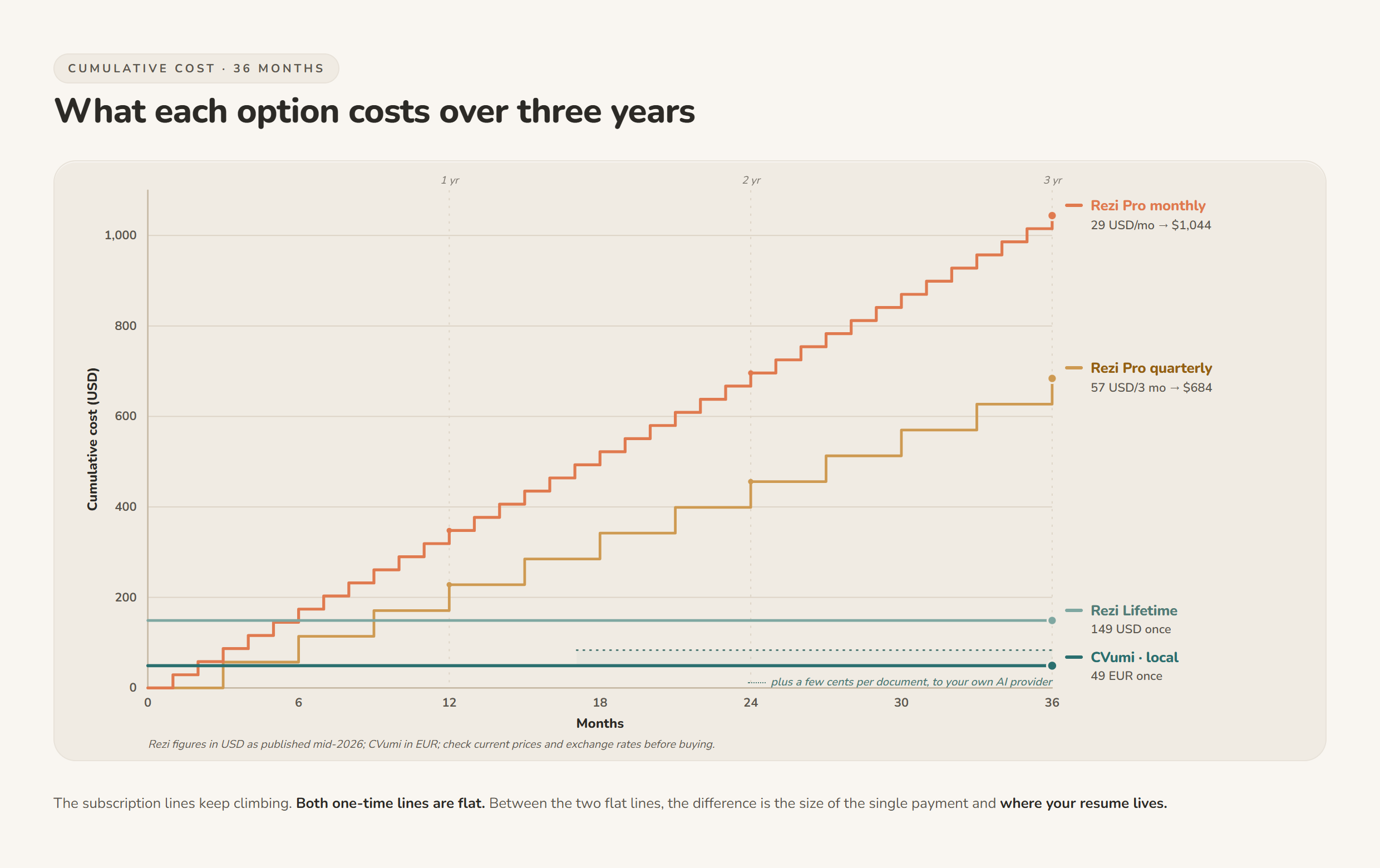
Read the chart honestly and it makes two separate points. Against any subscription, paying once is the cheaper line the moment your search runs past about half a year, which is exactly the case Rezi's own lifetime plan makes (the FTC's click-to-cancel rule exists because stopping a monthly charge is often made harder than starting one). Rezi lifetime is a good answer to that.
But look at the two flat lines. Rezi lifetime and a local one-time tool are both paid once, so neither keeps climbing. The gap between them is not the money over time, since both are flat. It is the size of the single payment, and it is where the file lives afterwards. That second part is the thing the chart cannot draw, and it is the reason the next section exists. If you want the fuller breakdown of pricing models across the whole category, we wrote one-time payment vs subscription resume builders, and if paying your own AI provider directly is new to you, bring-your-own-API-key resume tools, explained covers what that actually costs.
The cost that never shows on the invoice
Every price so far has been in money. The one that appears on no invoice is your data.
Your CV is one of the most revealing documents you own. Full name, home address, phone number, every employer, every date, sometimes a photo or your nationality. With any cloud resume builder, Rezi included, that document sits on the provider's servers under an account, whether you pay monthly or bought lifetime access. Lifetime does not change that. If anything, a lifetime account is one you are more likely to leave sitting there for years.
You do have rights over it. In the EU, the right to erasure under GDPR Article 17 lets you ask a company to delete your personal data, and it is worth using. It also has limits that are easy to miss. It reaches the copies a company controls, but backups and data already shared can linger, and the law lists cases where the right does not apply. Deleting a file after the fact is weaker than never uploading it. The most private copy of your resume is the one that never left your computer.
This is the real difference between the two flat lines on the chart. A local one-time tool charges once and keeps your files in a folder you choose on your own device, with no account behind them. That is a property of where the files live, not of the price tag, which is why a one-time cloud plan and a local tool are not the same alternative even when both cost you a single payment. The practical method for keeping career documents off other people's servers is in how to keep your career documents fully private.
What you give up by not using Rezi
An honest comparison runs both ways. A local one-time tool costs you things Rezi gives you, and you should weigh them.
You give up the browser convenience. Rezi opens on any machine you sign into, while a desktop app lives on the computers you install it on. You give up the big template gallery that cloud builders lean on. You give up bundled human review of the kind Pro includes, so if a professional eye on your draft matters to you, that is a real point for Rezi. And you take on managing your own files and your own backups, plus one setup step at the start if the tool asks you to bring your own AI key.
None of these are dealbreakers for someone whose priority is paying once and keeping their CV off the cloud. All of them are real. Pick the tradeoff you actually want, not the one a pricing page nudges you toward. If you would rather see the wider field than a single product, we compared several in the best privacy-friendly AI CV builders in 2026.
How to choose
The short version comes down to what you are optimising for.
Buy Rezi lifetime if you like Rezi, you are comfortable with your resume living in its cloud, and you want a browser tool with templates and the option of human review, paid for once instead of monthly. On those terms it is a sound deal.
Choose a local one-time tool if your priority is keeping your CV on your own machine, paying once, and turning a job posting into a complete tailored application rather than only a resume. If your search is short and light, Rezi's free tier or a month of Pro may be all you need, and there is no shame in the cheapest thing that works.
One caveat sits underneath all of it. No tool guarantees an interview, and if your applications are not landing, the problem is usually the CV itself rather than the software around it. That is a separate, fixable problem, and it is worth sorting out before you pay for anything. We cover it in why your CV keeps getting rejected.
How CVumi fits
CVumi is the local one-time option in the table above, so here is what it actually does, plainly. It is a desktop app for Windows and macOS with a one-time price: 69 EUR for a standard licence with three device activations, or 34 EUR with a student email. No subscription, no auto-renewal, and no per-application credit.
Your CV, your master profile and your past applications stay in a folder you choose on your own computer. CVumi runs no server that stores your documents, and the company never sees them. When an AI step runs, the request goes from your machine straight to the AI provider under your own key, so you pay the provider directly for usage, usually a few cents per document, and nothing is parked on a CVumi server in between.
From one job posting it writes a tailored CV, a matching cover letter and the covering email together, and its fit analysis shows where you genuinely match the role and where the honest gaps are, working only from your real experience. When the application is ready, one click opens your normal email client with the files attached, so you review and send it yourself.
The short version
Rezi's lifetime plan is a fair deal on its own terms. At 149 dollars once it beats paying 29 a month for anyone who job-hunts more than a few months, and Rezi is a capable builder. Just go in knowing what "lifetime" means: it lasts as long as the product does, it excludes the expert reviews Pro bundles, and it keeps your resume in Rezi's cloud rather than on your machine. A one-time payment answers the money question, not the data one.
If the alternative you actually want is a tool that charges once and keeps your career documents on your own computer, that is a different category from any cloud lifetime plan. Download CVumi. One payment, your files stay local, and you keep the key.