one-time payment resume builder
One-time payment vs subscription resume builders: what you actually pay
The number on the pricing page is rarely the number you pay. Here is what one-time and subscription resume builders actually cost, in money and in data, with real prices and where the hidden costs sit.
The number on a resume builder's pricing page is rarely the number you end up paying. A trial priced at a couple of dollars becomes a recurring charge you forgot to cancel. A tool billed "monthly" actually bills you thirteen times a year. And the cheapest-looking option can cost you the one thing there is no refund for, which is control over a document that carries your name, address, employers and dates.
This article breaks down what you actually pay for a resume builder, in money and in data, and compares the two pricing models honestly. Some subscriptions are fair. Some one-time tools are not private. The point is to show you where the real costs hide so you can choose with your eyes open. Most people who search for a one-time payment resume builder mean one thing by it: they have been surprised by a subscription and want to stop renting their own CV.
The sticker price is not the whole price
Most subscription resume builders share a shape. You pick a template, spend twenty minutes filling it in, and hit a wall at the moment that matters, which is downloading the finished file. To get past it you start a trial that costs very little, often between 1.85 and 2.95 US dollars as published in mid-2026, for seven to fourteen days. If you do not cancel in time, that trial converts to a full subscription.
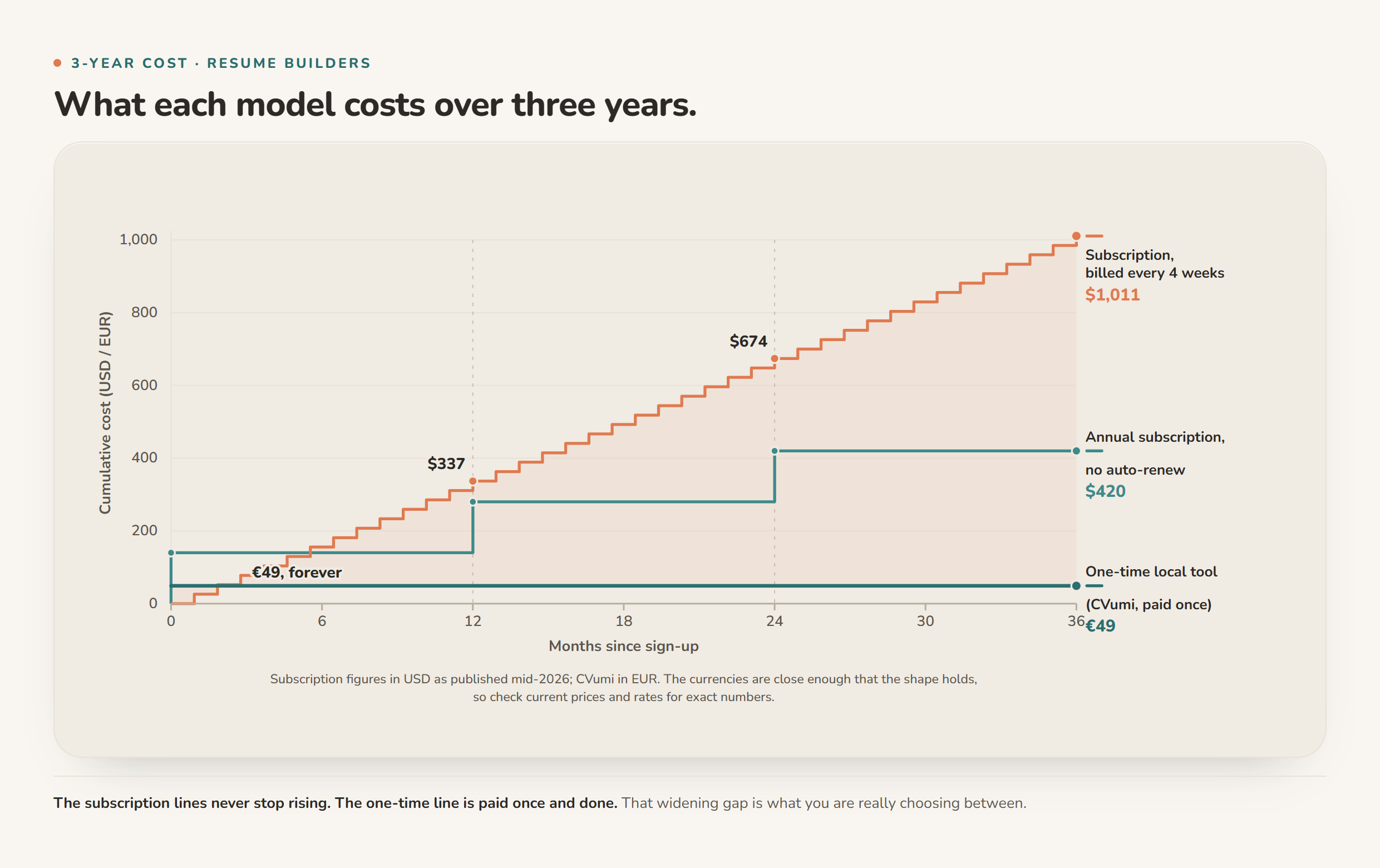
Here is the part that catches people. The full price is usually quoted "every 4 weeks", not "per month". Those are not the same. A year holds thirteen four-week periods, not twelve, so a plan billed every four weeks charges you thirteen times a year, about 8 percent more than a true monthly plan (A Media Operator). At a common rate near 26 dollars every four weeks, that works out to roughly 337 dollars a year, not the 26 the headline suggests. At 30 every four weeks it is closer to 390.
None of that is illegal, and not every builder plays it this way. Novoresume, for one, publishes a yearly price of 139.99 dollars and does not auto-renew. But the trial-to-subscription pattern is common enough that the US Federal Trade Commission wrote a rule about it, one that asks sellers to disclose the terms clearly, get your express consent before charging, and make cancelling at least as easy as signing up (FTC). The rule's legal status has been contested in court, but the enforcement and the underlying complaints have not gone away. If a service wants your card before it will let you download your own resume, read the renewal terms twice.
One-time payment resume builders: what you actually trade
A one-time payment resume builder charges once and lets you keep using what you bought. "Lifetime" usually means the same thing, access that does not expire, though it is worth checking whether "lifetime" also covers future updates or only the version you bought today.
Prices vary a lot, because the label covers very different products. WolfResume sells one-time tiers from about 7.99 to 24.99 dollars. ResumeZap sells a lifetime plan at 149 dollars. CVumi, the desktop app we make, is 69 EUR for a standard licence with three device activations, or 34 EUR with a student email, with no subscription and no per-application credit. Prices are as published in mid-2026, quoted in their original currencies, so check the current figure before you buy.
The honest tradeoffs of the one-time model are real, so here they are. You usually manage your own files instead of having them synced for you. If the tool uses AI, some ask you to bring your own API key, which means you pay the AI provider directly for what you use, often a few cents per document, rather than a flat fee that hides it. And you install your own updates rather than getting them pushed silently. For a lot of job seekers those are a small price for not renting access to their own work. For others, the hands-off convenience of a subscription is worth the money. Both are reasonable. The trick is knowing which one you picked.
One caveat matters most here. A one-time payment is not the same as privacy. Plenty of "one-time" and "lifetime" tools are still cloud web apps that store your resume on their servers exactly like the subscription ones do. You paid once, but your data still lives with them. The pricing model and the privacy model overlap, and they are not identical, which is why the rest of this article treats them as two separate questions.
What it adds up to over three years
Three years is a realistic horizon for a job search that includes a promotion hunt or a second move. Here is the same decision laid out across the costs that actually reach you, not just the sticker.
| What you pay | Subscription builder | One-time local tool |
|---|---|---|
| Upfront price | A low trial, often 1.85 to 2.95 dollars | The full price once, about 25 to 150 |
| Real first-year cost | Roughly 140 to 390 dollars, by plan and billing cycle | The one-time price, then nothing |
| Billing frequency | Often every 4 weeks, so 13 charges a year | Once |
| If you stop paying | You usually lose access to your resumes and downloads | You keep the app and your files |
| Where your resume lives | On the provider's servers | Wherever the tool stores it; local tools keep it on your device |
| Data reused per the terms | Common | Only if the tool sends it somewhere |
| AI usage cost | Bundled into the fee | Sometimes your own API key, billed by usage |
| Cancelling | A step you have to remember, sometimes hard to find | Nothing to cancel |
Now the shape over time. A subscription keeps climbing for as long as you hold it. A one-time payment is a flat line. That is the whole difference, and it is worth seeing drawn out.
The cost that never shows on the invoice: your data
Every price so far has been in money. The one that appears on no invoice is your data, and it is the reason the pricing model and the privacy model are linked at all.
A subscription needs a reason for you to keep paying. The most dependable reason is that the thing you made lives on the provider's servers, tied to an account, and you lose access to it the day you stop. Your resumes, your history, your saved versions are what make the subscription sticky. That is not a conspiracy, it is just how the model earns. The outcome is the same either way: a document listing your full name, address, phone number, every employer and every date sits on a server you do not control, usually kept and sometimes reused under terms you agreed to at sign-up.
You are not without recourse. In the EU, the right to erasure under GDPR Article 17 lets you ask a company to delete your personal data, and it is worth using. It also has limits that are easy to miss. It reaches the copies a company controls, but backups and data already shared can linger, and the law lists cases where the right does not apply. Deleting a file after the fact is weaker than never uploading it. The most private copy of your resume is the one that never left your machine.
This is where a one-time local tool can genuinely differ, and where the money question and the privacy question finally meet. A desktop app that charges once has no monthly hook, so it has no reason to hold your files to keep you paying. It can leave them on your device, in a folder you choose, with no account behind them. That is a property of where the files live, not of the price tag, which is exactly why the earlier caveat holds: check both. If you want the full method for keeping career documents off other people's servers, we wrote it up in how to keep your career documents fully private and in how to tailor a CV without uploading it to the cloud.
How to check what you will really pay, before you sign up
You can work out the true cost of almost any resume builder in about two minutes, before you type in a card. Run these checks:
- Find the real recurring price, not the trial. Look for the number you pay after the trial ends, and whether it is billed "per month" or "every 4 weeks". If it is every four weeks, multiply by 13, not 12.
- Find the cancel path before you start. If you cannot see how to cancel in the help pages or account settings before you pay, treat that as the price going up. The FTC expects cancelling to be as easy as joining, and not every tool clears that bar yet.
- Check whether the download is paywalled. Some builders let you design for free and only charge at export. That is fine when you know it is coming, and a bad surprise when you do not.
- Read the data section, not only the price section. Look for where your resume is stored, how long it is kept, whether it is used to "improve the service", and how deletion works. If you cannot find any of that, that is an answer too.
- Check whether the AI is metered. If the tool uses AI, find out whether it is included, capped, or sold as credits. A cheap-looking plan with per-generation credits can cost more than the headline.
- Add it up for your real timeline. If your search might run six months, price six months. If you expect to job-hunt again in two years, a one-time tool you still own then may be the cheaper line by a wide margin.
What you are really buying, in the end, is not templates. It is interviews. A tool that helps you tailor honestly and get read in a recruiter's short first scan is worth paying for, whether that is one payment or twelve. If your applications are not landing regardless of the tool, the fix is usually the CV itself, which we cover in why your CV keeps getting rejected and in how to get past ATS without keyword stuffing.
How CVumi handles it
CVumi is a desktop app for Windows and macOS, and it is a one-time payment: 69 EUR for a standard licence with three device activations, or 34 EUR with a student email. There is no subscription, no auto-renewal, and no per-application credit. You buy it once and keep using it.
Your resume, your master profile and your past applications stay in a folder you pick on your own computer. CVumi runs no server that stores your documents, and the company never sees them. When an AI step runs, the request goes from your machine straight to the AI provider under your own API key, so you pay the provider directly for usage, usually a few cents per document, and nothing is parked on a CVumi server in between.
From there it writes a tailored CV, a matching cover letter and a covering email together, and its fit analysis shows where you genuinely match a role and where the honest gaps are, working only from your real experience. When the application is ready, one click opens your normal email client with the files attached, so you review and send it yourself.
The short version
The sticker price on a resume builder tells you almost nothing. What you actually pay is the recurring charge, often thirteen times a year rather than twelve, plus the friction of stopping it, plus your resume sitting on a server you do not control. A one-time payment removes the first two. A local one-time tool can remove the third as well, as long as you confirm the files really stay on your device. Not every subscription is a trap, and not every one-time tool is private, so weigh both the money and the data against your own timeline.
If you would rather pay once and keep your career documents on your own machine, download CVumi. One payment, your files stay local, and you keep the key.