why is my CV getting rejected
Why your CV keeps getting rejected (and how to fix the gaps)
The scary version blames a robot. The honest version is simpler and more fixable. Here are the real reasons a CV gets rejected, how to tell which one is yours, and how to close the gap.
You send the application. Maybe you get an automated "thank you", maybe nothing at all. A week passes, then two, and the silence starts to feel personal. If you have caught yourself asking why is my CV getting rejected, you are asking the right question. The trouble is that most answers online start in the wrong place, with a story about a robot that bins three quarters of CVs before a human ever looks.
That story is mostly a myth, and believing it sends you chasing the wrong fixes. This guide gives you the honest version: what actually happens to a CV after you hit send, the real reasons a CV keeps getting rejected, a quick way to work out which reason is yours, and how to close each gap. The fixes work in any text editor. At the end I show how CVumi runs the same checks on your own computer.
The honest answer: it is usually not a robot
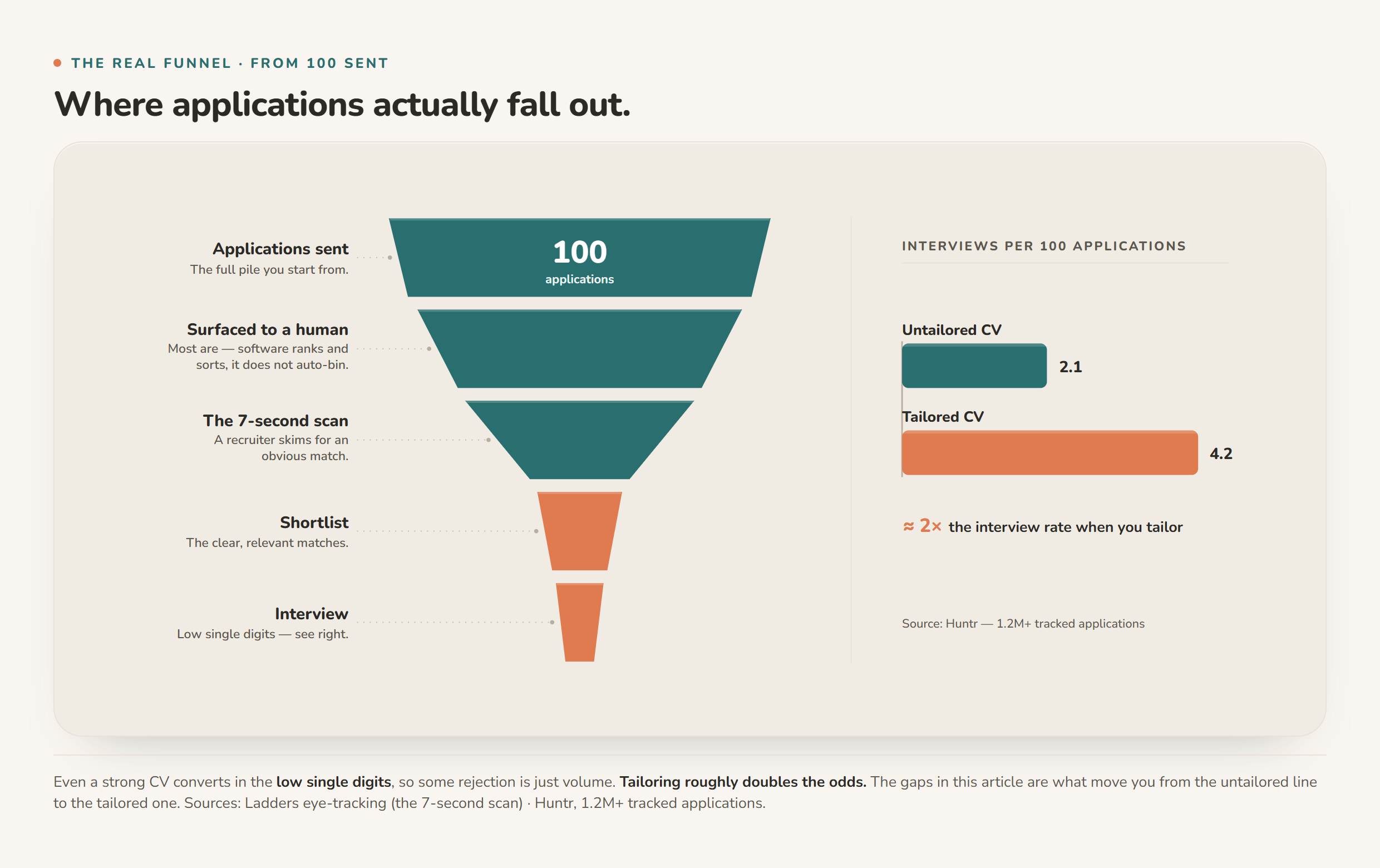
The claim that applicant tracking software auto-rejects 75 percent of CVs has no study behind it. It traces to a marketing line from over a decade ago, not to research, and it has been repeated ever since. What the software actually does is duller and more useful to understand. It reads your CV into fields, stores it, and lets a recruiter search and rank the pile. Around 99 percent of large employers use one, but most rank and surface CVs for a person rather than quietly discarding them (Harvard Gazette). Some do filter on hard rules the employer sets, such as the right to work in the country or a required licence, so genuine must-haves matter. There is no secret score you have to beat.
The real gatekeeper is a busy person with too many CVs and not enough time. Eye-tracking research from Ladders found recruiters spend about 7.4 seconds on the first pass over a CV (HR Dive). Seven seconds is not a careful read. It is a glance for one thing: is this obviously the right person for this job? If the answer is not clear at that glance, the CV goes on the "no" pile, and a person makes that call, not a machine.
One more piece of honesty helps here. Even a strong, well-matched CV gets rejected often, because a lot of people apply to each role. Huntr, tracking more than a million applications, found that CVs tailored to the posting reached an interview about 4.23 percent of the time, against 2.07 percent for generic ones (Huntr). Both numbers are low. So some of your rejections are simply volume, and the goal is not zero rejection. The goal is to move from the lower line to the higher one, which roughly doubles your odds. The gaps below are how you get there.
The real reasons a CV gets rejected
Almost every fixable rejection comes down to a gap between what the job asked for and what your CV made easy to see in seven seconds. Here are the seven that come up most, and what each looks like from the other side of the desk.
| The gap | What the recruiter sees | The fix |
|---|---|---|
| Relevance | A CV that could go to any job, not this one | Tailor to the posting and mirror its real terms where they are true of you |
| Clarity | Titles, dates and results buried, nothing to grab in a 7-second skim | Standard sections, one column, bold job titles, your best result high up |
| Evidence | Duties listed, no outcomes or numbers | Turn "responsible for X" into what changed, with a figure |
| Errors | A typo, the wrong company name, a dead phone number or email | Read it aloud, check the contact line, fix the name for each application |
| Machine readability | A scrambled parse: text stuck in images, tables, headers or footers | Plain layout, real text, standard headings, export in the format asked for |
| Unexplained history | A gap, a short stay or a career switch with no context | One honest line that frames it, not a cover-up |
| Hard filters | A missing must-have: right to work, a licence, the location | Read the posting for genuine must-haves before you apply |
The first two, relevance and clarity, cause more rejections than the rest combined, because they are exactly what a seven-second scan is testing. The others still count, and a single bad one, a typo in your own name or a phone number missing a digit, can sink an otherwise strong CV on its own.
How to tell which gap is yours
Before you rewrite anything, work out what is actually wrong. Guessing leads to busywork.
- The seven-second test. Hand your CV to a friend for seven seconds, take it back, and ask what job they think it is for. If they cannot say, you have a relevance or clarity problem, and that is where to start.
- Line them up. Put the job posting next to your CV and go through the requirements one by one, marking each as clearly shown, buried, or missing. The buried ones are a clarity fix. The missing-but-true ones are a relevance fix. The missing-and-not-true ones may be why this particular role was never a match.
- Read it out loud. Typos and clumsy lines are easier to catch by ear than by eye. This is also the fastest way to find the wrong company name left over from your last application.
- Check the plumbing. Email the CV to yourself, open it on your phone, and try the contact details. A surprising number of applications fail because a phone number is wrong or the file opens as a scrambled mess.
- Look at the ratio, not one rejection. If you have applied to 30 well-matched roles and heard nothing, that points at the CV. If you have applied to five, some silence is normal and you may just need more shots on goal.
How to fix the gaps, in order of impact
Work through these in order. The first two move the needle most, so do not spend an evening polishing wording before the CV even points at the right job.
- Relevance first. Tailor the CV to the posting. Use its own words for skills and responsibilities where they are honestly true of you, and put the most relevant experience and results near the top, where the seven-second scan lands. This is the single biggest lever, and it is why tailored CVs interview at roughly twice the rate. For a full method you can run privately, see how to tailor a CV to a job description without uploading it to the cloud.
- Clarity next. The Ladders study found the CVs that survived the scan used simple layouts, clear section headings, bold job titles and bulleted results, while cluttered, multi-column pages with long sentences did worse. Stick to standard headings such as Experience, Education and Skills, use one column, and put your strongest, most relevant result high on the page.
- Turn duties into results. "Responsible for social media" tells a recruiter nothing. "Grew the newsletter from 2,000 to 9,000 readers in a year" tells them what you can do. You do not need a number on every line, but the top two or three should show an outcome.
- Kill the errors. Fix typos, correct the company name for each application, and test your contact details. It is boring, and it is worth more than another hour spent on wording.
- Frame the gaps in your history, do not hide them. An employment gap, a short stay or a career change is not an automatic rejection. What gets rejected is the unexplained version, because the reader fills the silence with the worst guess. One honest line, such as "took a year to care for a family member" or "completed a six-month retraining course", is usually enough. If you are weighing how to order a thin or mixed history, balancing recent experience against education walks through it.
- Make it machine-readable. Keep important text out of images, tables, headers and footers, use real text and standard headings, and export in the format the posting asks for. You can mirror the employer's terms honestly without cramming the page, and making an ATS-friendly CV without keyword stuffing shows exactly where that line sits.
When it is not your CV
Sometimes you do everything right and still get a no, and it helps to know that is normal rather than a signal to rewrite the CV a seventh time. Roles get filled by an internal candidate before the posting comes down. A hiring freeze lands the week you apply. The employer set a hard must-have, a specific licence or on-site work in a city you cannot reach, that no wording can change. Capable people also get screened out by over-strict criteria, which is the real finding behind the research on hiring software: the systems can hide qualified applicants who do not fit a narrow filter (Harvard Gazette). If your CV passes the seven-second test and lines up with the posting, send it, then move to the next one without reading a verdict into every silence.
A two-minute self-diagnosis checklist
- A stranger can name the target job after a seven-second look.
- The posting's main requirements are shown clearly, not buried, and each one is true of you.
- Job titles, employers and dates sit in plain, standard sections.
- The top of the page carries your most relevant result, with a number.
- No typos, the right company name, and contact details that actually work.
- Any gap or short stay has a one-line, honest frame.
- The file opens cleanly as a PDF, with no scrambled layout and no text trapped in images.
If every line is true and you are still hearing nothing after 20 or 30 well-matched applications, the problem is more likely your target roles or the market than your CV, and a conversation with someone working in the field will tell you more than another edit will.
How CVumi finds the gaps, on your own computer
CVumi is a desktop app for Windows and macOS. Your CV, your master profile and your past applications stay in a folder you choose on your own machine, and you decide what, if anything, ever leaves the device.
It reads a job posting against your real history and shows the fit: where you clearly match, where a true strength is buried, and where there is an honest gap. It works only from what is already true about you, so it flags a missing requirement rather than inventing one to cover it.
When a line is weak, you can highlight it and ask the app to reword just that one, turning a flat duty into a result and using the posting's term where it fits, leaving the rest of the CV untouched.
From there it writes a tailored CV, a matching cover letter and a covering email together, in several languages and formats, including the German Lebenslauf. When the application is ready, one click opens your normal email client with the files attached, so you review and send it yourself.
CVumi is a one-time payment: 69 EUR for the standard licence with three device activations, or 34 EUR with a student email. There is no subscription and no per-application credit. If you want the whole process end to end, see how to go from a job link to a ready-to-send application.
The short version
Most rejected CVs are not unqualified. They are unclear, or aimed at no job in particular, and both of those are fixable in an afternoon. Run the checklist on your next application, close the gap a seven-second scan would catch, and you have already done more than most of the pile.
If you would rather have these checks handled on your own machine, download CVumi. One payment, your files stay local, and you keep control of your own history.