experience vs education on a CV
How to balance recent experience vs education on a CV
Should education or experience go first on your CV? The honest answer depends on your career stage and the job. Here is a simple way to decide, plus how CVumi helps.
Open almost any advice thread about CVs and the same question comes up. Should education go at the top, or should your work experience lead? People want one rule to follow, and the honest answer is that there is not one. What goes first depends on where you are in your career and on what the job asks for. Handled well, experience vs education on a CV is a quick judgement, not a rule to memorise.
This guide gives you a way to decide. You will see the default order most CVs use, the handful of cases where you should break it, and how much detail each section actually needs. It works in any text editor. At the end I show how CVumi does the same on your own computer, using only what is already true about you.
What balancing experience and education actually means
Balance is not a fifty-fifty split down the page. It is a question of order and space: which section the reader sees first, and how much room each one takes. Reviewers do not study a CV from top to bottom on the first pass. An eye-tracking study by Ladders found recruiters spend an average of about seven seconds on a CV before deciding whether to keep reading (HR Dive). Whatever sits in the top third has to carry your strongest case for the job.
Inside each section the default is reverse chronological order, most recent first. MIT's career team describes the usual shape for a student this way: the education section comes next after your header, and the bulk of the page then goes to your experiences (MIT CAPD). The useful move they point to is a relevant experience section, where you pull the history a specific reader cares about toward the top. Whichever section makes your best case for this job is the one that goes there.
The default rule, and when to break it
Here is the rule that covers most people. If you are still studying, or you graduated recently and have little full-time work behind you, put education near the top. Once you have a year or two of relevant experience, let that experience lead and move education down.
MIT's guide for first-year students says it plainly: "Although you may see education at the top of most resumes, it might not always go there (especially after you graduate and build experience), but for most first-year students I recommend keeping it at the top" (MIT CAPD).
Early on, your degree, your grades and your projects are the best evidence an employer has that you can do the work. A few years in, what you have actually done on the job is stronger proof, so it earns the top spot and your education shrinks to a line or two. You are not hiding your studies. You are letting the better evidence go first.
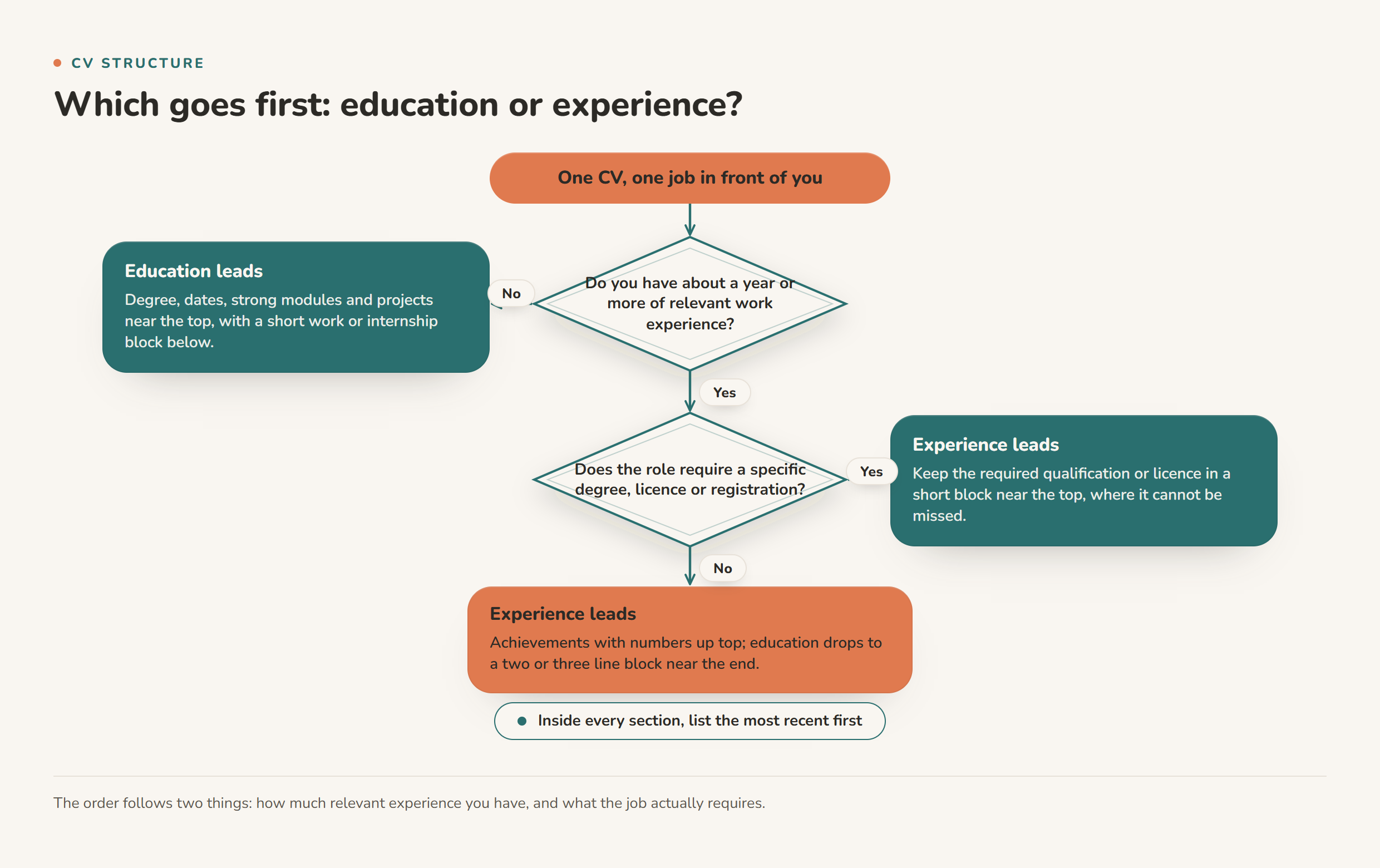
When education leads and when experience leads
Your career stage does most of the deciding. This table maps the common situations to what should lead, how much space to give education, and why. Find the row closest to you and start there, then adjust for the specific job.
| Your situation | What leads | Education detail | Why |
|---|---|---|---|
| Current or final-year student | Education | Degree, expected date, strong modules, projects, GPA while it helps | Your studies are the main proof you can do the work |
| Graduated in the last year, little full-time work | Education, with an internship or projects block close behind | Degree plus internships, placements and real projects | Early on, internship and project work carries real weight |
| Two or more years of relevant experience | Experience | A short block near the end: degree, institution, year | What you have done at work now says more than your grades |
| Changing career or field | A skills or relevant-experience group | Brief, unless the new field needs the qualification | You are selling transferable proof, not a timeline |
| Regulated or academic role (law, medicine, teaching, research) | Education, licences and registrations | Full detail, including any required registration | The qualification is a hard gate for the job |
| Senior professional, ten years or more | Experience and results | One line: degree and institution | No one is hired at that level on a GPA |
How to decide in five minutes
You do not need to agonise over this. Run these five checks against the posting in front of you.
- Name your strongest evidence for this job. Not in general, for this exact posting. It might be a relevant degree and a standout project, or three years doing the actual work. Whatever it is, that section goes in the top third.
- Check the posting for hard requirements. Some roles genuinely require a specific degree, a licence or a professional registration. If the ad lists one, put it where a reader cannot miss it near the top, even when experience leads the rest of the page.
- Keep reverse chronological inside each section. Most recent first. It is what recruiters and screening software expect, and a clever reordering usually just makes the timeline harder to follow.
- Give the weaker section less room, not none. If experience leads, education can be three lines at the end. If education leads, your short work history still belongs on the page, labelled honestly.
- Match the split to the job, not to a template. Berkeley's career team is blunt that there is no single best format, and that it depends on what you have done and what you are trying to accomplish. A skills-led layout can suit someone with little work history or a career change, while a straight chronological CV suits a more conservative field (Berkeley Career Engagement).
How much detail each section needs
Education, in order of usefulness. The degree and the institution first, then the dates, then anything that still proves something. While you are new to work, that means strong modules, a dissertation or capstone, academic honours, and a GPA if it helps your case. Drop the coursework and the GPA once you have real jobs that say more than a grade does. If a qualification is still in progress, list it honestly with the expected date rather than a date that implies you finished.
Experience, always the same test. Results, not duties. "Cut report preparation from three days to one" beats "responsible for reporting", and you can defend the number when someone asks. Lead each line with its strongest word, keep the roles that matter for this job, and trim the rest. If a student job or an internship proves a skill the posting wants, it belongs on the page, even under an education-led CV.
Situations that trip people up
- An employment gap. Do not bury it by scrambling the order into something a reader cannot follow. Keep the timeline clear and account for the gap in a line if that helps. A confusing CV reads worse than an honest gap. If your applications keep going quiet, why your CV keeps getting rejected looks at the gaps behind the silence.
- A degree in progress or unfinished. List it with the real status, such as "expected 2027" or the credits completed, never a finish date you did not reach. A line you can explain beats a claim you cannot.
- Self-taught or a bootcamp route. Put the proof where it is strongest. A portfolio, shipped projects and paid freelance work often say more than a course name, so lead with the work and keep the training short.
How CVumi balances the two, on your computer
CVumi is a desktop app for Windows and macOS. Your CV, your master profile and your past applications live in a folder you choose on your own computer. When you tailor a role, it reads the job description and your history locally, and you decide what, if anything, leaves the device.
Its fit analysis lines the posting's requirements up against your real experience and shows what your strongest evidence for this job actually is, whether that is a degree, a project or three years on the job. That is the section that belongs in your top third. It works only from what is already true about you, so it never invents an achievement or a qualification to fill a gap.
From there it writes a tailored CV, a matching cover letter and a covering email together, in any of several languages and formats, including the German Lebenslauf. When the application is ready, one click opens your normal email client with the files attached, so you review and send it yourself.
One honest point. CVumi orders and words what is already true about you. It does not add a degree you do not have, and it does not promise interviews. The judgement about what to lead with stays yours. The app just makes it quick to try both orders and see which one reads stronger.
CVumi is a one-time payment: 69 EUR for the standard licence with three device activations, or 34 EUR with a student email. There is no subscription and no per-application credit. For the wider tailoring method, see how to tailor a CV to a job description without uploading it to the cloud. To use the job's own words without overdoing it, read how to customise a CV for ATS without keyword stuffing. If you are weighing a one-off tool against a monthly one, see one-time payment vs subscription resume builders.
A quick checklist before you send
- The top third of the CV holds your strongest evidence for this specific job.
- The leading section matches your stage: education while you are new to work, experience once you are not.
- Any hard requirement the posting names, a degree, a licence or a registration, is easy to find.
- Inside every section, entries run most recent first.
- Education detail fits your stage, full while it proves something and a short block once your work says more.
- Every claim, in both sections, is something you can defend in an interview.
- You kept one honest master CV and tailored a copy of it, rather than inventing anything new.
Balancing experience and education is mostly a question of order. Put your strongest true evidence for this job first, and give the rest a proper, smaller place. Get that order right and the reader spends their seven seconds on the part of your history that fits the role.
If you would rather have these steps handled on your own machine, download CVumi. One payment, your files stay local, and you send every application yourself.