employment gap on CV
How to explain an employment gap on your CV in one honest line
A gap is not the problem, the silence around it is. Here is how to frame an employment gap in one honest line, where to put it, and the mistakes that make it look worse than it is.
A three-month gap feels enormous while you are the one staring at it. To a recruiter skimming for a few seconds, an unexplained gap is not a scandal. It is a small question mark, and the reader answers it with a guess. That guess is usually worse than the truth. The whole job of explaining an employment gap on your CV is to answer the question before the reader invents an answer for you.
This guide keeps it practical. You get a one-line method that covers most gaps, the format that shows a gap in its best light, examples you can adapt, and the mistakes that make a gap look worse than it is. It all works in a plain text editor. At the end I show how CVumi does the same on your own computer, using only what is already true about you.
Gaps are common, and pretending otherwise helps no one
You are not an outlier. A 2022 LinkedIn survey of about 23,000 workers found that nearly two-thirds had taken some kind of career break (Harvard Business Review). Caring for a child or a relative, redundancy, illness, study, burnout, a move to another country: the reasons are ordinary, and most reviewers have seen every one of them.
Being common does not make a gap invisible. That same piece is titled, plainly, "Resume Gaps Still Matter," and the honesty helps. A gap can still cost you when you leave it unexplained, because the reader fills the silence with a worst-case story. The goal is not to hide the gap. It is to remove the question mark. If your applications keep going quiet, an unexplained gap is one of the usual suspects behind a CV that keeps getting rejected.
The one-line rule: name it, frame it, move on
Most gaps need exactly one line. Name what happened, keep it neutral, and where you honestly can, add one detail that shows you stayed active. Then stop. Over-explaining signals that you think the gap is a problem, and the reader takes the hint.
A line that works has three parts:
- What it was, in plain words: a career break, caregiving, redundancy, study, recovery.
- The dates or duration, so the timeline stays honest and continuous.
- One forward detail, only if it is true: a course, freelance work, volunteering, keeping a certification current. No true detail? Leave it out rather than invent one.
Put it where the gap would otherwise sit
The cleanest place is inside your work history, as its own short entry, so the timeline never breaks:
Career break, caring for a family member (2024 to 2025) Completed an online data-analysis course during this period.
That single entry does more than a paragraph of defence. It closes the hole in the timeline and gives the reader a reason in the same glance they use to read your job titles.
One honest line for common situations
Adapt these to your own truth. A frame you cannot back up in an interview is worse than the gap it covers.
| Reason for the gap | A one-line frame you can adapt |
|---|---|
| Redundancy or layoff | Role ended in a company restructure. Used the time to complete [course]. |
| Caring for family | Career break to care for a family member, 2024 to 2025. |
| Health or recovery | Planned break for health reasons, now resolved and available to work. |
| Raising children | Career break to raise young children. Kept skills current with freelance [work]. |
| Study or retraining | Full-time [course] at [institution], 2024 to 2025. |
| Still job seeking | Actively seeking a new role since [month]; completed [project] in the interim. |
| Relocation | Relocated from [country] to [country] and re-established the right to work. |
Show duration, not just exact dates
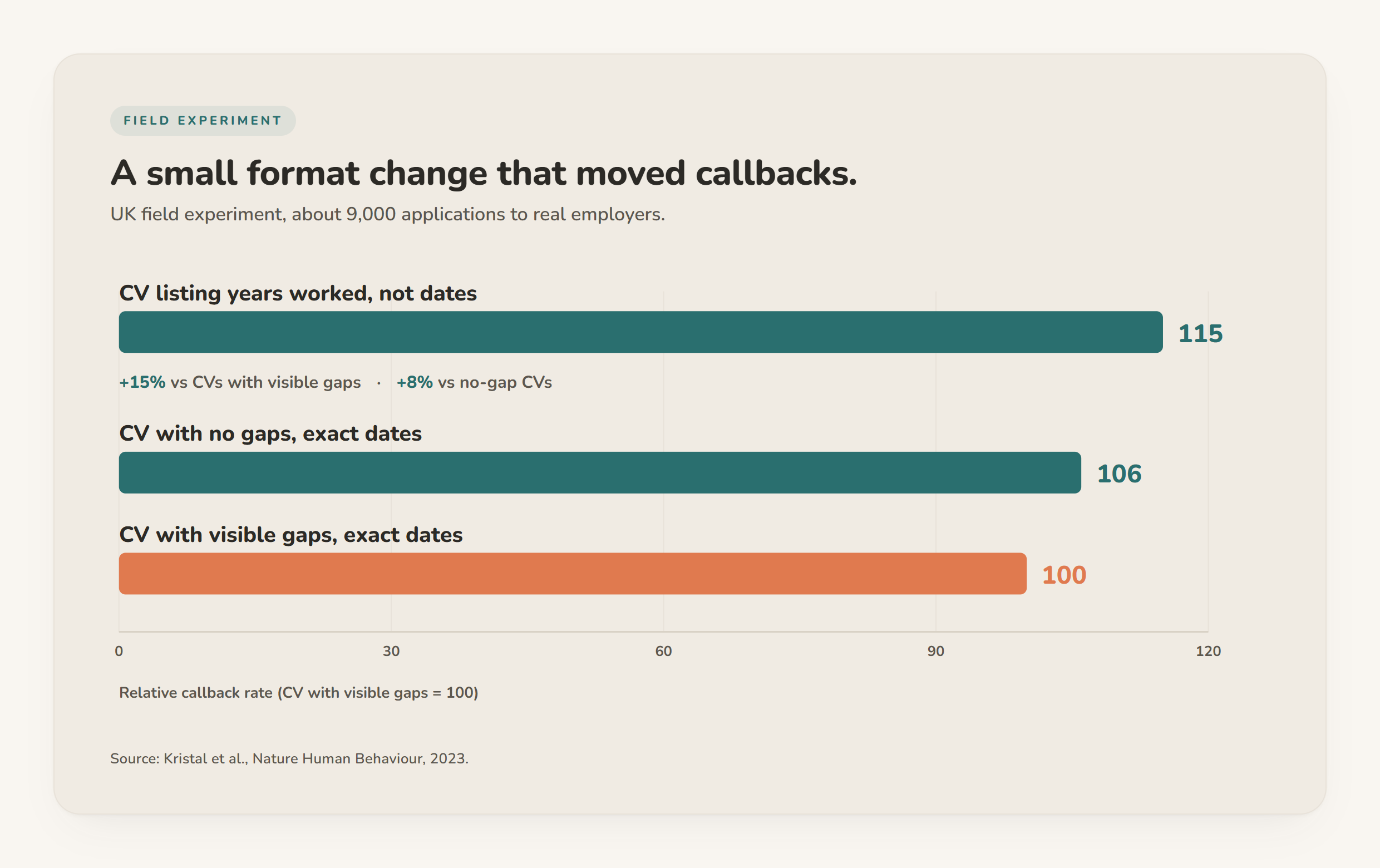
How you print the dates changes how a gap reads. In a preregistered field experiment in the UK, researchers sent roughly 9,000 applications to real employers and tested one small change: instead of exact start and end dates for each role, the CV listed the number of years worked. That single format shift raised callbacks by about 15 percent compared with CVs that showed visible employment gaps, and it edged ahead of CVs with no gaps at all by about 8 percent (Nature Human Behaviour).
The reason is human. Showing "3 years" instead of "March 2019 to April 2022" makes your experience the thing the reader notices, and a reader focused on your years is not counting the months between two jobs.
| Format | How a role appears | What the reader notices |
|---|---|---|
| Exact dates | Analyst, Acme, Mar 2019 to Apr 2022 | The precise months, and any gap before the next role |
| Duration | Analyst, Acme, 3 years | Your years of experience, not the space between roles |
Use judgement. Some forms and some employers ask for exact months, and a few screening systems expect them. When they do, give them. Showing duration is an honest way to lead with your experience, not a trick for hiding a timeline. The gap is still there if someone asks. You have simply chosen to lead with what you did.
What not to do
The fastest way to turn a normal gap into a real problem is to handle it badly. Avoid these.
- Do not lie about dates. Stretching a job's end date to cover a gap is easy to catch through references or a public profile, and it turns an ordinary gap into a trust problem, which is far harder to recover from.
- Do not leave it blank and hope. The unexplained gap is the one that hurts, because the reader guesses. One plain line beats silence every time.
- Do not over-explain or apologise. A paragraph of justification, or the word "unfortunately," makes a small thing look large. Name it, frame it, move on.
- Do not overshare. "Career break for health reasons" is enough. You are not obliged to detail a diagnosis, a bereavement or a dismissal. Brief and neutral wins.
- Do not invent a freelance business to fill the space. If you did real freelance or volunteer work, list it. If you did not, a plain "career break" is more credible than a company no one can verify.
- Do not scramble the order to bury the gap in a layout no one can follow. A confusing CV reads worse than an honest gap. If you are unsure how to arrange a mixed history, balancing recent experience against education walks through the ordering.
How CVumi handles gaps honestly, on your computer
CVumi is a desktop app for Windows and macOS that runs locally. Your CV, your master profile and your past applications stay in a folder you choose on your own machine, and nothing leaves the device until you send it.
Its fit analysis reads a job posting against your real history and shows where you match and where there is a genuine gap. It flags the gap plainly rather than papering over it, because it works only from what is already true about you and never invents a role or an achievement to fill the space. That is exactly what you want: the gap named and framed, not hidden behind a fiction that unravels in the interview.
When you want to phrase the gap well, highlight the entry and ask the app to reword just that one line, keeping it neutral and forward-looking, with the rest of the CV untouched. You can also set the format and balance: show roles by duration or by exact dates, lead with recent work or with skills, and pick a layout from a clean one-pager to a classic German Lebenslauf.
From there it writes a tailored CV, a matching cover letter and a covering email together, in English, German, French, Spanish, Polish, Italian or Portuguese. It can also generate interview questions from the actual posting, so you can rehearse the gap answer before anyone asks it. When the application is ready, one click opens your normal email client with the files attached, so you review every word and send it yourself.
CVumi is a one-time payment: 69 EUR for the standard licence with three device activations, or 34 EUR with a student email. There is no subscription and no per-application credit. You bring your own API key, so the analysis runs on your machine, under your control. For the wider method, see how to tailor a CV to a job description without uploading it to the cloud.
Try CVumi on your own gap
A gap on your CV is a question, not a verdict. Answer it in one honest line, show your years of experience rather than every month, and leave the reader nothing to guess at. Do that and the gap stops being the thing they remember about you.
If you would rather have the gap named, framed and worded on your own machine, download CVumi. It reads your real history locally, flags the gap instead of hiding it, and helps you write the one honest line that closes it. One payment, your files stay on your computer, and you send every application yourself.