do AI resume checkers work
Do AI resume checkers actually work?
The 75% ATS rejection stat is made up, the same resume can score 66 or 99, and a human still reads yours in about seven seconds. Here is what an AI resume checker is genuinely good for.
You paste your CV (or resume, the tools use the American word) into a free checker, wait a few seconds, and a number appears: 62 out of 100. Red text warns that your CV may be rejected. So you reword it, run it again, and now it says 81. Nothing about your experience changed. Only the phrasing did.
That gap is the whole story of AI resume checkers. They are useful for one narrow, mechanical job and misleading for almost everything else. Here is an honest look at what they measure, what the score really means, and why the scariest statistic behind them was never real.
The short version
An AI resume checker is worth running to catch a CV a machine cannot read: a broken layout, a missing section heading, a hard skill the posting asks for that you forgot to name. It is not worth trusting as a verdict on whether you will get the interview. The score is soft, it changes between tools, and sometimes it changes on the same tool for the same file. Treat it as a spell-checker for machine-readability, not a grade.
Where the "75% get rejected" number came from
Almost every scare piece about resume screening repeats a version of the same line: 75% of CVs are rejected by the applicant tracking system before a human ever sees them. It is a made-up number. Careers researchers have traced the figure to Preptel, a resume-optimisation vendor that used it in marketing around 2012. Preptel shut down in August 2013 and never published a study, a dataset, or a method behind it. That is why the same claim drifts between 70, 75 and 88 percent depending on who repeats it. There was no original to pin down (Uncharted Career).
What does have research behind it is more nuanced, and more useful. The Harvard Business School and Accenture report Hidden Workers: Untapped Talent found that 88% of employers agree qualified higher-skilled candidates get filtered out of the process, rising to 94% for middle-skills roles, and it estimates more than 27 million hidden workers in the United States alone (Harvard Business School). But read how it happens. Joseph Fuller, who led the research, describes recruiters setting variables in the software: require a degree, exclude anyone with an employment gap over six months, demand an exact number of years. The candidate is removed by a filter a person configured, not by an algorithm quietly binning a PDF for using two columns.
That distinction changes what you should fix. If your CV keeps vanishing, the cause is far more likely to be a mismatch against the criteria a recruiter set than a font the parser disliked. We go deeper into that in why your CV keeps getting rejected.
What an AI resume checker actually measures
Most checkers produce two things. First, a completeness or format score for the CV on its own. Second, and only if you paste in a specific job description, a match score based on keyword overlap between your CV and that posting.
The format score
The mechanical half is where these tools earn their keep. Applicant tracking systems really are everywhere: Jobscan's 2025 audit detected an ATS at 97.8% of Fortune 500 companies, 489 out of 500, with Workday alone on close to 40% of them (Jobscan). Those systems extract the text from your file into structured fields. If your layout hides job titles inside an image, splits content into columns the parser reads in the wrong order, or buries dates where the software cannot find them, a good checker will flag it. That feedback is concrete and worth acting on.
The keyword match
The keyword half helps in one specific way: it tells you which hard requirements from a posting you have not named. If the job asks for "financial modelling" and you wrote "built forecasts", a literal matcher marks it missing. Adding the exact phrase where it is genuinely true is fair. Inventing it is not, and it is also the fastest way to get caught in the interview.
The seven-second reality no checker can see
Here is what a score out of 100 will never tell you: whether a human wants to read on. The widely cited Ladders eye-tracking study found recruiters spend an average of 7.4 seconds on the first pass over a CV, up from six seconds in 2012 (HR Dive). In those seconds their eyes go to your current title and company, then the previous one, then dates, then education, in a rough E or F shape down the page. CVs that survived had simple layouts, clear headings and bulleted results. The ones that failed were cluttered, multi-column and short on white space.
An AI checker can confirm the ATS can read your file. It cannot tell you whether a tired recruiter, on the fortieth CV of the morning, will care about the top third of your page. Both things have to be true. Passing the parser gets you into the pile; the seven seconds decide whether you leave it.
Why the same resume scores 66 one minute and 99 the next
If you have ever run one CV through two checkers and got wildly different results, you are not imagining it. Two things are going on.
The first is that tools match differently. Modern systems like Workday and Greenhouse do semantic matching, so "led a team" can register against "team leadership". Weaker checkers still reward only exact string matches, so they score the same CV lower and send you chasing keywords you already covered in other words.
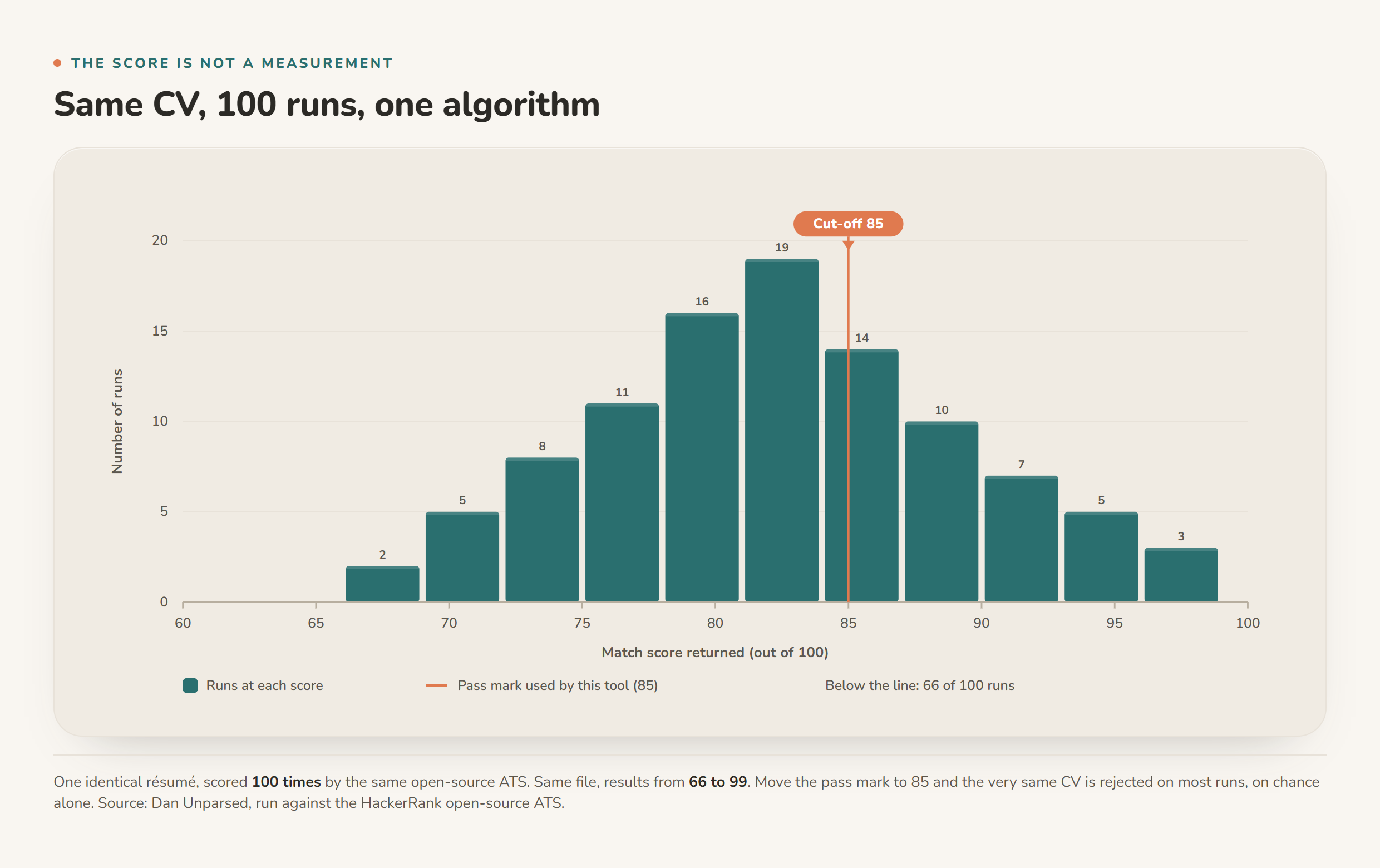
The second is stranger. Many AI checkers are built on language models that sample with a degree of randomness, so the score moves even when nothing else does. One engineer ran the same resume one hundred times through HackerRank's open-source ATS and got scores anywhere from 66 to 99, which he summed up as "same exact resume, different luck" (Dan Unparsed). Checklist items such as a named technical skill scored consistently. Anything requiring a judgement call swung hard. With a cut-off at 85, that identical CV failed roughly two runs in three on chance alone.
So the number is a soft signal, not a measurement. Use it to compare two versions of your own CV under identical settings, never as a pass mark.
What to trust, and what to ignore
| What the checker reports | How much to trust it | What to do |
|---|---|---|
| "Your file did not parse" or a missing section | High | Fix the layout: one column, real text, no images of words |
| Specific hard keywords missing vs a posting | High | Add the ones that are genuinely true, in context |
| An overall score out of 100 | Low | Compare your own drafts; ignore the absolute figure |
| "You will (or will not) pass the ATS" | Very low | Systems rank and filter; a person still reviews |
| A design or style "grade" | Low | The seven-second human scan matters more than a rubric |
| Suggested achievements or rewrites | With caution | Never accept a result you cannot back up in person |
How to actually use one
A checker is a proofreader, so treat it like one.
Paste the real job description every time; a score with no posting attached is just a generic rubric. Read the list of missing keywords rather than the headline number, and add only what is true. Do not let a tool pad your CV with achievements you did not earn to lift a score, because that is the opposite of what survives an interview. If you want the full method for matching a posting without keyword stuffing, we wrote it up in customise your CV for the ATS without keyword stuffing.
One more thing that rarely makes the sales pages: privacy. Most free checkers upload your CV, and often your entire work history, to their servers to run the scan. If you would rather your documents not become someone else's training data, that is worth checking before you paste. We compared the options in the best privacy-friendly AI CV builders for 2026.
An honest answer to an honest question
So, do AI resume checkers work? For proofreading machine-readability and spotting missing keywords, yes, and that alone can save you from a self-inflicted rejection. As a judge of whether you fit the role, no. They reward gaming a number, they disagree with each other, and some of them disagree with themselves on a rerun.
That gap is why we built CVumi to do something different. Instead of a score out of 100, it runs an honest fit analysis: it compares the real job posting against your actual history, flags the gaps that are genuinely there, and never invents an achievement to make the page look better. It runs on your own Windows or Mac machine with your own Anthropic key, so your CV and work history stay in a folder you choose and nothing leaves the device until you send it. When the CV and cover letter are ready, one click opens your email client with both attached, for you to read and send.
If you are tired of chasing a number that changes on every run, download CVumi and get feedback you can actually act on.