application email
The application email: what to write in the message that carries your CV
The message you type when you attach your CV is not your cover letter, and a bare 'please find attached' wastes it. Here is what to put in the subject line and body, and how short to keep it.
You have tailored the CV, written the cover letter, and attached both. Then you reach the one part almost nobody plans for: the email itself. Most people type "Please find my CV attached", press send, and hope. That message is your application email, and it is the first thing the employer reads, before either attachment is opened. Treating it as a throwaway line wastes the one piece of the application you write last and they read first.
The application email is not your cover letter. It is the short covering email that carries your documents and tells the reader what they are looking at. This guide covers what to put in the subject line, what the body should say, how brief to keep it, how to handle the attachments, and a two-minute check before you send.
The covering email is not the cover letter
This is the distinction that trips people up. The cover letter makes the case: why you, why this role, one story that proves it. The covering email is logistics with a human touch: who you are, which role, and a pointer to the attachments. When you attach a cover letter, the email should stay short and send the reader to it. As Jenny Foss writes for The Muse, be brief and point the reader to the attachments, and do not repeat yourself if you are also attaching a letter (The Muse).
That short email still matters, because the accompanying message is often read early. In a Resume Genius survey of 625 hiring managers, 45 percent said they read the cover letter before the CV (Resume Genius). The email sits one step earlier still. It sets the first impression the rest of the application then has to live up to.
The failure mode is doing too much. People either paste the entire cover letter into the email and attach it as well, so the reader gets the same text twice, or they write nothing and let "see attached" stand in for a greeting. Neither reads as considered. The table below is the quick version of who does what.
| Covering email | Cover letter | |
|---|---|---|
| Its job | Say what is attached, and who you are | Make the case for why you fit |
| Length | Three or four sentences | About one page, near 400 words |
| Where it lives | The body of the email | A PDF attachment (or the email body if there is no separate letter) |
| Tone | Brief, professional, warm | Considered, specific, evidenced |
| What to avoid | Retelling the letter | Retelling the CV |
The subject line does one job
The subject line is not where you sell yourself. Its job is to get your email filed correctly and found again later, sometimes weeks later when a hiring manager searches a full inbox for your name. So make it plain. USF Career Services suggests a simple pattern: your name, the word application, and the position title, for example "Jane Smith, Application, Marketing Coordinator" (USF Career Services).
Two things override any template. First, read the posting. If it asks for a reference number or a specific phrase in the subject, use exactly that, word for word, because a recruiter may be filtering the inbox on it. Second, keep it short enough to read on a phone, where a long subject is cut off before the useful part.
| Vague subject | Clear subject |
|---|---|
| Application | Jane Smith, Application, Marketing Coordinator |
| My CV | Priya Patel, Data Analyst, ref DA-204 |
| Job enquiry | Tom Lang, Application, Junior Designer |
What the body should say, and how short
Keep the body to three or four sentences. The person opening it is moving quickly. An eye-tracking study by Ladders found recruiters spend an average of 7.4 seconds on a CV before deciding whether to keep reading (HR Dive), and the Resume Genius survey found 36 percent of hiring managers spend under 30 seconds on a cover letter (Resume Genius). The email that carries both gets even less patience than that. Say the essential things and stop.
A body that works has four short moves:
- A proper greeting, to a named person if the posting gives one.
- One line on who you are and which role you are applying for.
- One line on why, the single most relevant reason, not the whole letter.
- A closing line pointing to the attachments, then a professional sign-off with your contact details.
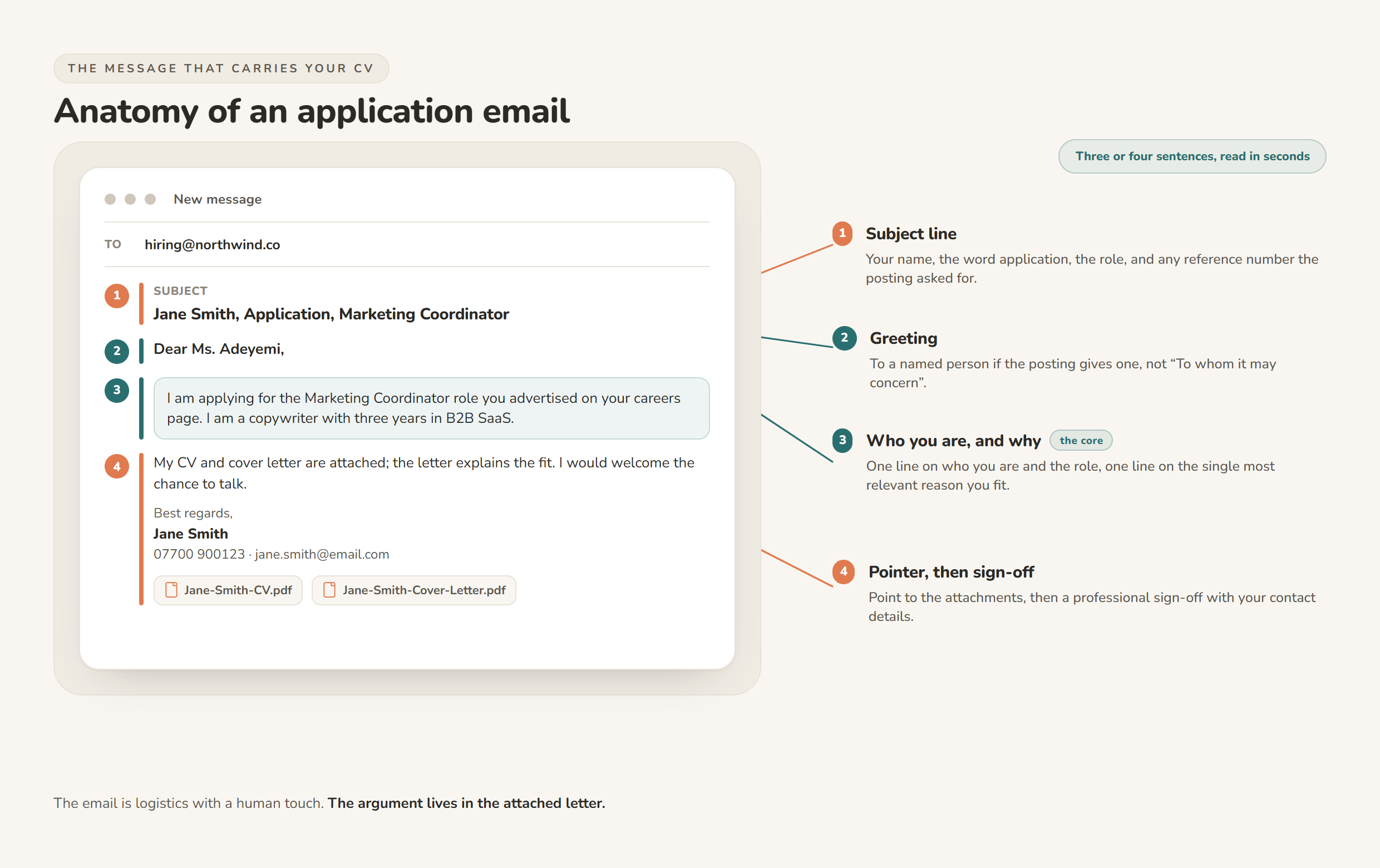
A body you can adapt
Use this as a shape, not a script. Fill the brackets with your own detail, and cut anything that does not sound like you.
Subject: [Your name], Application, [role title]
Dear [name],
I am applying for the [role title] position advertised on [where you saw it].
I am a [one-line description] with [the single most relevant strength for
this role].
My CV and cover letter are attached. The letter explains why this role in
particular is a good fit. I would welcome the chance to talk.
Best regards,
[Your name]
[phone] | [email]
Attachments: name them like a person, send PDF
Two small habits here save you from the errors that get an otherwise good application filed under no.
Name the files so a stranger can identify them at a glance. USF's advice is to save the document under a distinguishable name such as JaneSmithResume rather than the generic Resume.doc, so the employer can tell whose it is (USF Career Services). Firstname-Lastname-CV.pdf and Firstname-Lastname-Cover-Letter.pdf work well. Send PDF unless the posting asks for something else, because it opens the same way on every machine, and the Resume Genius survey found hiring managers prefer receiving documents that way (Resume Genius).
Body or attachment, not both
Decide where the cover letter goes, then do not double up. You either write the cover letter into the email body or attach it as its own file, not both. The Muse notes the choice is unlikely to make or break you either way, so follow the posting if it specifies one, and otherwise attach a separate PDF and keep the email short (The Muse).
Two more details that quietly matter. Send from a sensible address, your name at a normal provider, not a joke handle from years ago. And check the attachments are actually attached before you send. Forgetting the file, or attaching last week's version for a different job, is one of the most common and most avoidable ways to sink an application.
A two-minute check before you send
Read the email out loud once, then confirm:
- The recipient's name and the company name are correct. A message addressed to the wrong company is the fastest route to the no pile.
- The subject line has your name, the role, and any reference number the posting asked for.
- The body is three or four sentences, and every claim in it is true.
- Both files are attached, named clearly, and open cleanly as PDFs.
- Any instruction from the posting, a reference, a question to answer, a required format, is followed.
Send it from your own client so a copy stays in your Sent folder. When a reply lands two weeks later, that copy tells you exactly what you sent.
Where CVumi fits
Here is the honest part. You can write a good application email by hand in five minutes with the template above, and you do not need an app to do it. What is harder is keeping the email, the cover letter, and the CV consistent with each other, and getting all three ready without uploading your history to someone else's server.
That is the work CVumi handles. It is a desktop app for Windows and macOS that runs on your own machine. Your CV, your master profile, and your past applications stay in a folder you choose, and nothing leaves the device until you send it. It reads a job posting against your real history and shows an honest fit analysis, where you clearly match and where there is a genuine gap, working only from what is already true about you rather than inventing an achievement to fill a blank.
From that one profile it writes a tailored CV, a matching cover letter, and the covering email together, in English, German, French, Spanish, Polish, Italian, or Portuguese. Because all three come from the same source, they agree with each other by construction. When the application is ready, one click opens your normal email client with the CV and cover letter already attached, so the last thing you do is read it once and press send yourself.
CVumi is a one-time payment: 69 EUR for the standard licence with three device activations, or 34 EUR with a student email. There is no subscription and no per-application credit, and you bring your own API key, so the writing runs under your own terms. For the whole route from a saved job link to a sent application, see step by step, from a job link to a ready-to-send application. For keeping the letter and the CV telling one story, see how to write a cover letter that matches your CV. And for the tailoring itself, run locally, see how to tailor a CV to a job description without uploading it to the cloud.
Send the email you would want to receive
The application email is small, and it is still the first thing a stranger reads about you. Keep the subject plain enough to file, the body short enough to read in seconds, and the attachments named so anyone can tell what they are. Do that and the message gets out of the way, which is exactly its job: to hand the reader a CV and a letter worth their time.
If you would rather have the CV, cover letter, and covering email written together from your own profile, and attached with one click, download CVumi and try it on your next application. One payment, your files stay on your own machine, and you send every application yourself.