cover letter matching CV
How to write a cover letter that matches your CV (without repeating it)
Matching your CV does not mean repeating it. It means one consistent story across both, with the letter adding what the CV cannot. Here is how to line them up, and what to leave out.
You have tailored your CV, checked the dates, and lined up your best results. Then you open a blank page for the cover letter and, out of habit, start summarising that same CV in paragraph form. That is the moment most cover letters go wrong. A letter that just retells the CV wastes the one document a recruiter often reads first, and a letter that quietly contradicts the CV, a different date here, a job title that never appears there, does worse than nothing.
Matching your cover letter to your CV is not about making them identical. It is about making them agree, and making the letter carry what the CV cannot. In a Resume Genius survey of 625 hiring managers, 94 percent said the cover letter influences who they decide to interview, and 45 percent said they read it before the CV (Resume Genius). If nearly half read the letter first, it sets the expectation your CV then has to meet. This guide shows how to keep the two consistent, how to structure the letter so it adds instead of repeats, and what to cut.
Matching means alignment, not duplication
Your CV and cover letter are one application, read by one person, usually within a minute or two of each other. Matching means they tell the same story with the same facts. It does not mean the letter lists the same bullet points as full sentences.
The distinction matters because the letter can move the decision on its own. In the same survey, 49 percent of hiring managers said a strong cover letter can win an interview for an otherwise borderline candidate, while 18 percent said a weak one can sink an otherwise strong CV (Resume Genius). Effort shows either way: 72 percent said customising the letter is important, and 78 percent said they can tell when an applicant has actually tailored it. A letter that reads like a reformatted CV signals the opposite, that you sent the same pair to everyone.
The three things that must line up
Before you worry about wording, get these three in agreement. A reader who spots a mismatch stops trusting the rest of the page.
The facts
Dates, job titles, employer names, and qualifications have to be identical across both documents. If your CV says "Marketing Manager, 2021 to 2024" and your letter says "I led marketing for the best part of three years, up to last year", the reader now has to reconcile two versions of the same fact. Pick one source of truth, the CV, and make the letter defer to it. This is the most common consistency error, and it reads as carelessness at best.
The priorities
Whatever your CV leads with is what the letter should open on. If the CV puts your recent engineering role and its headline result at the top, the letter should not spend its first paragraph on a side project. When the emphasis of the two documents disagrees, the reader cannot tell what you actually want to be hired for.
The vocabulary
Use the same words for the same things, in both documents and in line with the posting. If the advert and your CV both say "customer success", do not switch to "client relations" in the letter. Consistent terms make you easy to match to the role, and easy is what you want when someone is reading quickly.
A structure that mirrors the CV
Keep the letter to about one page. The Resume Genius survey puts the average recommended length at around 400 words, and PDF is the format hiring managers prefer (Resume Genius). Within that, three moves keep it aligned with the CV.
- Open on your strongest, most relevant fit. Name the role, then lead with the same strength your CV leads with. One or two sentences, no throat-clearing.
- Expand one or two CV lines into evidence. This is where the letter earns its place. The CV says what you did and the result. The letter says how, and why it mattered. Pick the achievement that maps most directly to the posting and tell it properly.
- Close with what you want and a plain sign-off. A short line asking for a conversation is enough. Do not restate the whole letter.
What to cut
Most weak cover letters are too full, not too empty. If something is already obvious from a glance at the CV, the letter does not need it. Cut:
- Your full work history retold in prose.
- The entire skills list. Name only the two or three skills that matter for this role, inside a sentence.
- Generic openings such as "I am writing to apply for the position of".
- Dates, tools, and titles the CV already carries.
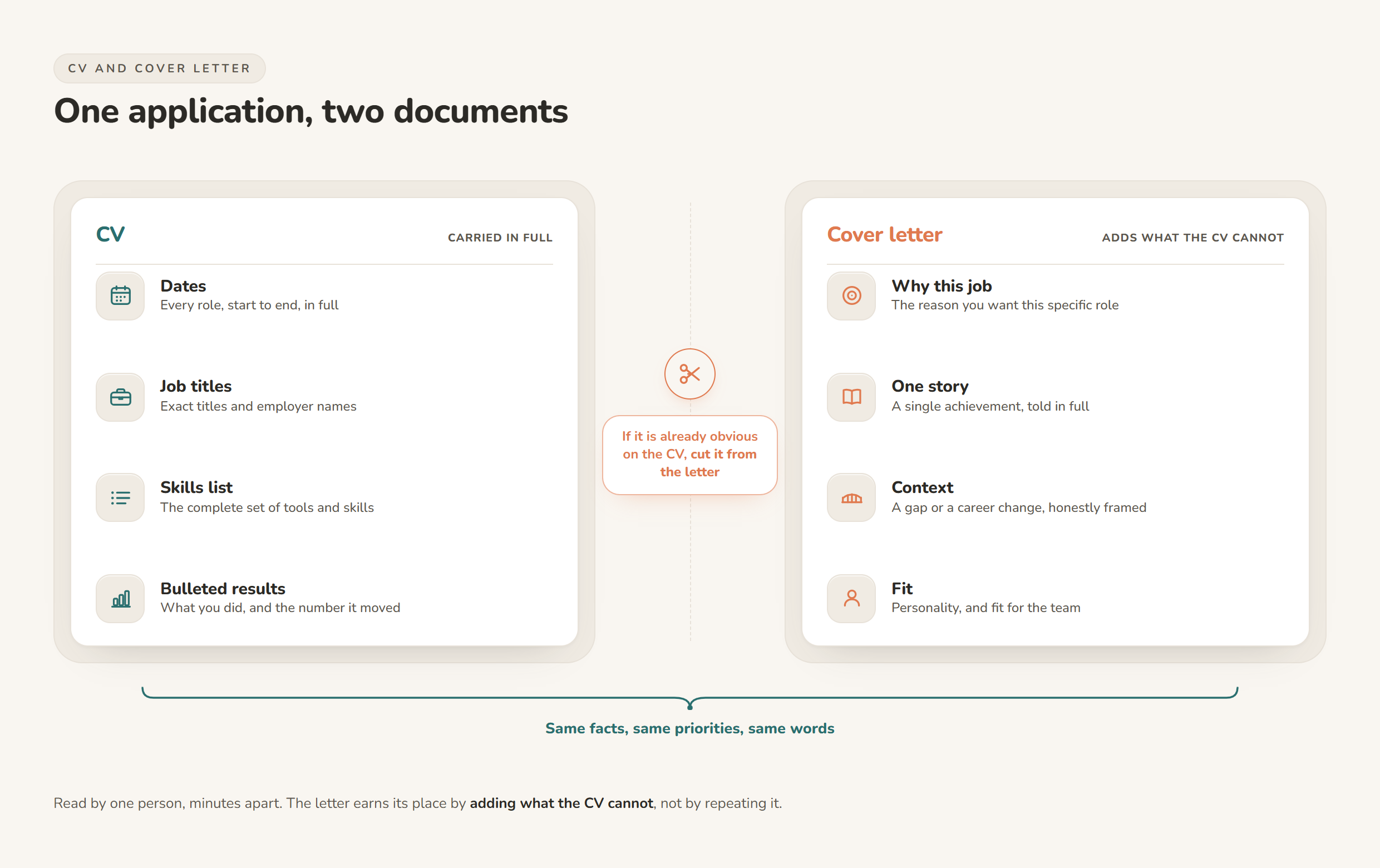
Keep only what the CV cannot: why you want this specific job, the context behind a move or a gap, and one story told in enough detail to stick. The table below is a quick way to decide where each piece belongs.
| Element | Put it in the CV | Put it in the cover letter |
|---|---|---|
| Full job history, dates, titles | Yes, in full | No, do not restate |
| Skills and tools list | Yes, complete | Only the two or three that matter here, in a sentence |
| Metrics and results | Yes, as bullets | One, expanded into a short story |
| Why you want this job | Not really | Yes, this is its main job |
| Context for a gap or a career change | A one-line note | A sentence of honest framing |
| Personality and fit for the team | Hard to show | This is where it lives |
Tailor both, to the same job
Consistency breaks the moment you tailor one document and not the other. A sharp, targeted CV sent with a generic letter, or the reverse, still reads as a half-effort application, and hiring managers can tell. The payoff for doing both is real. Huntr, analysing its full set of tracked applications, found tailored CVs reached an interview 4.23 percent of the time against 2.07 percent for untailored ones, a 2.04 times lift (Huntr). The same logic applies to the pair as a whole. Read the posting, choose the two or three requirements you genuinely meet, and make sure both documents lead with them, in the same words.
If your applications keep going quiet, it is worth checking the CV side of the pair too. Why your CV keeps getting rejected covers the gaps a quick scan catches, and how to tailor a CV to a job description without uploading it to the cloud walks through the tailoring method the letter should match.
Write the CV, letter, and email from one source
The most reliable way to keep a letter and CV consistent is not to proofread them against each other afterwards. It is to generate both from the same profile at the same time, so the dates, titles, and story cannot drift apart in the first place.
This is how CVumi works. It is a desktop app for Windows and macOS that runs on your own machine. Your CV, your master profile, and your past applications stay in a folder you choose, and nothing leaves the device until you send it. It reads the job posting against your real history and shows an honest fit analysis: where you clearly match, where a real strength is buried, and where there is a genuine gap. It works only from what is already true about you, so it flags a missing requirement rather than inventing an achievement to cover it.
From that one profile it writes a tailored CV, a matching cover letter, and a covering email together, in English, German, French, Spanish, Polish, Italian, or Portuguese. Because all three come from the same source, they agree by construction. When the application is ready, one click opens your normal email client with the CV and letter attached, so you review and send it yourself.
CVumi is a one-time payment: 69 EUR for the standard licence with three device activations, or 34 EUR with a student email. There is no subscription and no per-application credit. You bring your own API key, so the writing runs on your terms. For the whole process end to end, see how to go from a job link to a ready-to-send application.
Keep the pair honest
A matching cover letter is a small promise: that the person in the letter and the person on the CV are the same, and that both are telling the truth about the same job. Keep the facts identical, let the letter add the why the CV cannot show, and cut everything the CV already proves. Do that and you have an application that reads as one considered piece, not two documents that happened to arrive together.
If you would rather have the CV, letter, and email written from one profile so they cannot drift apart, download CVumi and try it on your next application. One payment, your files stay on your own machine, and the pair stays in sync because it came from the same place.