how long should a CV be
How long should a CV be? One page, two pages, by region
One page or two? The honest answer depends on where you are applying and how far into your career you are. Here are the real length norms, the recruiter studies behind them, and how to cut a CV that runs long.
Ask ten people how long a CV should be and you get ten confident answers, half of them contradicting the other half. The reason is simple: there is no single correct length. There is a correct length for your career stage, in the country you are applying to, for the kind of role you want. A one-page rule that is gospel in New York is quietly wrong in London, and a length that suits a graduate would look thin for a director.
This guide gives you the real norms, backed by recruiter studies rather than folklore: how length changes by region and by seniority, why the famous one-page rule is mostly an American habit, and a practical method for cutting a CV that has run too long.
The one-page rule is mostly an American rule
The instruction to keep everything on one page comes largely from US hiring culture, where the document is called a resume and brevity is prized. Even there, the rule is softer than people repeat it. Indeed's own guidance recommends one page "especially for students, new graduates and professionals with one to 10 years of experience", and reserves three pages for people "with over 25 years of continuous related working experience or those in fields such as academia or medicine" (Indeed).
So even the home of the one-page resume treats one page as a strong default, not a hard ceiling. Cross the Atlantic and the default itself changes. In the UK and most of Europe the everyday document is called a CV, and two A4 pages is the normal expectation for an experienced applicant, not a sign that you failed to edit. If the terminology trips you up, we untangle it in CV vs resume: the differences across Europe.
What the evidence actually says about length
Two well-known studies get quoted constantly, usually to prove opposite points. Read carefully and they do not contradict each other; they measure different moments.
The first is the initial skim. A 2018 eye-tracking study by Ladders found recruiters spend an average of about 7.4 seconds on the first pass of a CV before deciding whether to keep reading (HR Dive). That is the quick yes-or-no glance, and it is why the top third of page one has to carry your strongest case.
The second is the full review, once you clear that skim. ResumeGo ran a hiring simulation in which 482 US recruiters and hiring managers assessed 7,712 resumes, half one page and half two pages. Recruiters were 2.3 times as likely to prefer the two-page version overall, and rated it higher for quality, 8.6 out of 10 against 7.1 (ResumeGo). The preference was not flat across roles. It grew with seniority.
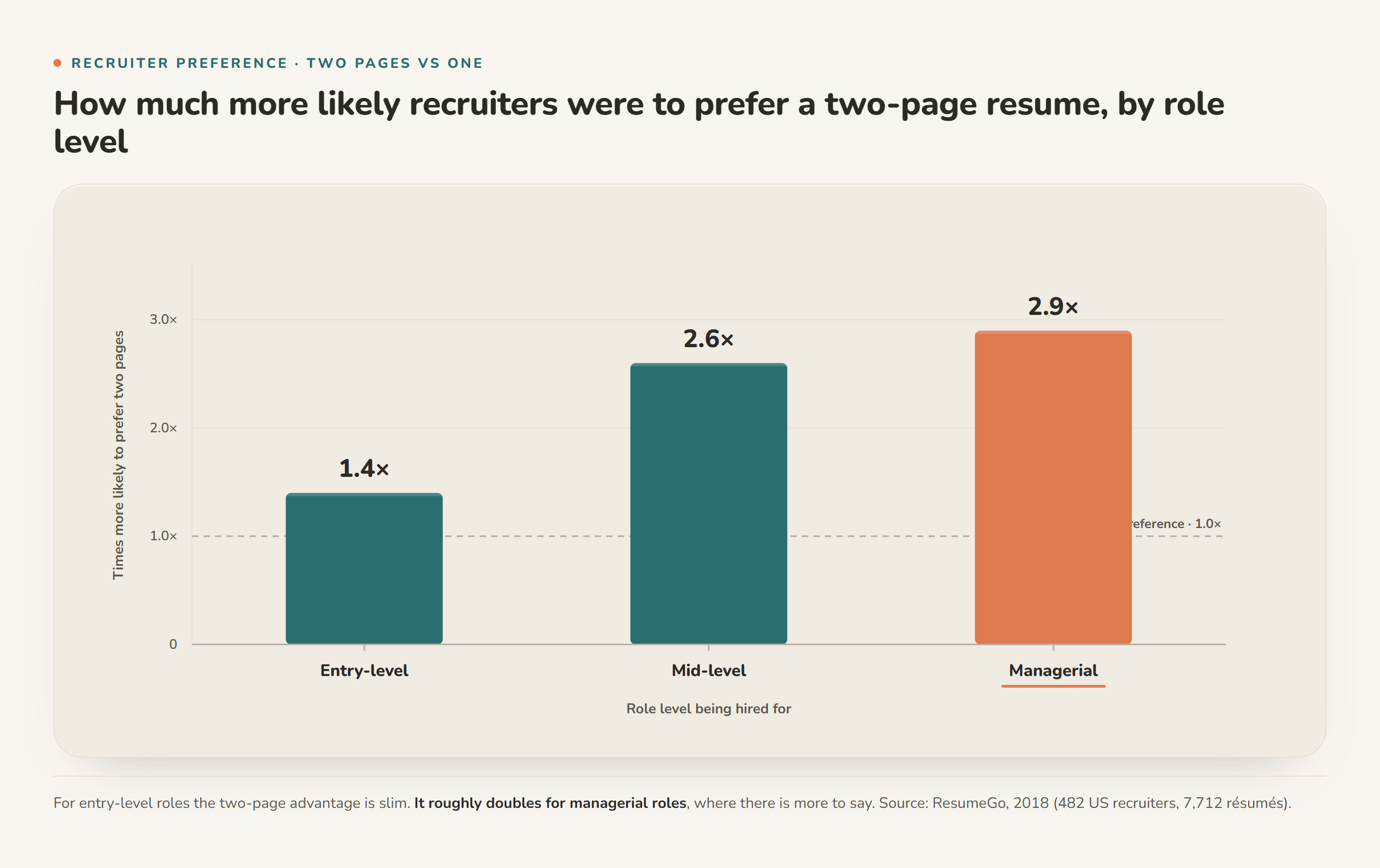
The honest reading: a short skim decides whether you get read at all, so page one must be tight. Once you are read, extra length is not penalised when it carries real substance, and it helps more the more senior the role. Recruiters are not counting pages. They are checking whether every line earns its place.
How long a CV should be, by region
Where you apply changes the default. The table below is a starting map, not a rulebook, and a specific job advert always beats a general rule.
| Region | Common term | Typical length | Notes |
|---|---|---|---|
| United States / Canada | Resume | 1 page, 2 when justified | New graduates one page. Three pages only for 25+ years or academia and medicine. |
| United Kingdom / Ireland | CV | 2 pages (A4) | The two-page CV is the default for experienced applicants. New graduates can use one. |
| Germany | Lebenslauf | 1 to 2 pages | Tabular, reverse-chronological, tightly structured. Precision matters more than volume. |
| France | CV | 1 to 2 pages | Concise and formal. One page is common earlier in a career. |
| Rest of continental Europe / Europass | CV | 1 to 3 pages | The Europass template can run long. Keep it to two pages where you can. |
| Academic / research (any country) | CV | Several pages, no fixed limit | Publications, grants and teaching make it a different document (see below). |
A few specifics beyond the table. In the UK, Reed describes two pages as "the sweet spot" for most professionals, with typical two-page CVs running roughly 700 to 1,000 words (Reed). Germany's Lebenslauf rewards a tight, well-ordered one-to-two pages rather than length for its own sake; if you are applying there, build to that format instead of stretching a British CV, and our German Lebenslauf guide walks through it. Across Europe generally, two pages is a safe target, and the personal data a European CV carries is a good reason not to pad it with anything an employer does not need.
How long a CV should be, by seniority
Region sets the default, but your career stage moves it up or down. Find the row closest to you.
| Career stage | Target length | Why |
|---|---|---|
| Student or new graduate | 1 page | You have less history, and one focused page reads stronger than a padded two. |
| 1 to 10 years of experience | 1 to 2 pages | Two pages is fine once you have results worth the room. Do not stretch to fill it. |
| 10+ years or senior | 2 pages | There is more to say, and the two-page preference is strongest here. |
| Academic or research | As long as the record needs | The CV lists your full scholarly output, not a highlight reel. |
The through-line is that length should follow evidence, never the reverse. A graduate who pads to two pages weakens page one. A director who crushes twenty years onto one page throws away their strongest material. Match the space to what you genuinely have to prove for this role.
Academic and research CVs are a different document
If you are applying for a PhD, a postdoc, a fellowship or a faculty post, forget the page rules above. Here the CV is meant to be comprehensive. Yale's Office of Career Strategy describes the academic CV as "extensive and cumulative, often spanning several pages to include all your academic achievements and contributions", in contrast to the concise, tailored resume (Yale OCS). Publications, conference presentations, grants, teaching and committee work all belong on it, and a five-page CV for an early-career researcher is unremarkable. Trying to trim an academic CV to two pages sends the wrong signal entirely.
How to cut a CV that has run too long
Most length problems are not "I have too much to say". They are "I have not decided what matters for this job". Cutting is editing, and editing has a method. Work through it in order and stop when you hit your target.
- Cut old and irrelevant roles first. Jobs from more than ten to fifteen years ago, and anything unrelated to the role you want, can shrink to a single line or disappear. Nobody is hired on a Saturday job from 2009.
- Turn duties into results, then delete the duties. "Responsible for reporting" is filler. "Cut monthly reporting from three days to one" is evidence, and it takes the same space while doing far more work. When a bullet does not prove anything, remove it.
- Collapse your education once experience outweighs it. A few years in, your degree becomes a two or three line block near the end. Give the room back to your work. Deciding what leads is its own small skill, and we cover it in how to balance recent experience vs education on a CV.
- Fix the layout before you cut more content. Wide margins, a heavy header, a photo you do not need in that market, and single-column lists that waste horizontal space all cost lines. Tightening the layout often buys back half a page without deleting a word.
- Keep one bullet per point. If two lines make the same claim, one of them goes. Repetition reads as padding even when the content is real.
Read the result cold. If a line does not help this specific employer say yes, it is taking space from one that would.
When the CV has to fit a hard page limit
Sometimes the limit is not advice, it is a rule. An application portal caps the upload at two pages, a graduate scheme asks for one, or a funder specifies an exact format. In those cases the danger is a tool that "fits" your CV by silently cropping the last role or shrinking the text until nobody can read it.
The better approach is to decide what earns the space before anything is cut, so the version that fits still makes your case. That is a choice about priority, applied under a firm ceiling. Keep your full history intact somewhere, and generate a trimmed version for the application rather than permanently cutting down your only copy.
How CVumi handles length, on your own machine
Getting length right is one of the things CVumi is built to make quick. It is a desktop app for Windows and macOS that runs locally, so your master profile and every CV you generate stay in a folder you choose on your own computer, not on someone else's server.
Two features do the work here. Its balance controls let you dial how much room goes to recent work, to education and to skills, so you can shift the weight toward your strongest evidence for a role instead of reordering blocks by hand. And it respects a page limit properly: ask for one page or two and it fits your content to that length without cropping a role or shrinking the text to an unreadable size, working only from what is already true about you rather than padding to fill a page or hide a gap.
You keep one accurate master profile, then generate a tailored CV, a matching cover letter and a covering email for each role, in the format and one of the languages you pick, including the German Lebenslauf. When it is ready, one click opens your email client with the documents attached, so you review the final length and send it yourself. Nothing leaves your device until you do.
On cost, CVumi is a one-time payment: 69 EUR for the standard licence with three device activations, or 34 EUR with a student email. No subscription, no per-application charge.
One honest limit. The right length gets your CV read fairly. It does not guarantee an interview. It removes an avoidable reason a good application gets set aside, and the rest of the search is still yours to run.
The short version
- There is no universal length. One page suits students and new graduates, two pages suits most experienced professionals, and academic CVs run as long as the record needs.
- The one-page rule is largely American, and soft even there. In the UK and Europe, two A4 pages is the normal default.
- Recruiters skim for about 7.4 seconds before deciding to read on, so page one must be tight. Once you are read, real substance is not penalised for taking a second page, especially at senior level.
- Cut by relevance, not by page count: old roles, duties without results, and a heavy layout go first.
- For a hard page limit, decide what earns the space before you trim, and keep your full history somewhere safe.
Tired of guessing whether your CV is too long or too thin for the job in front of you? Download CVumi, set the length you need, and let it fit your real history to one page or two without cropping a thing. One payment, and every version stays on your own machine.