ChatGPT vs CV builder
ChatGPT or a dedicated CV builder? An honest comparison
ChatGPT writes better sentences than most CV builders. It also cannot lay out an A4 page, keep your history consistent across ten applications, or stop itself inventing a job you never had. Here is the honest split.
ChatGPT is a genuinely good writer. It will sharpen a weak bullet point faster than most humans and it costs nothing to try. So the question is fair: why pay for a CV tool at all?
The answer is not that ChatGPT is bad. It is that writing sentences is roughly a third of the job, and it is the third ChatGPT is best at. The other two thirds are layout and consistency, and a chat window is the wrong shape for both.
What ChatGPT is genuinely better at
Give it credit where it is due.
Rewriting a specific sentence. Paste one weak bullet, ask for three sharper versions, pick one. This is a real strength and it is free.
Explaining a job advert. Ask what a vague title actually means, or which of the listed requirements are the real ones. Good, fast, useful.
Interview preparation. Generating likely questions from a public job description works well, and there is no privacy cost because the advert is already public.
Unblocking a blank page. When you cannot start, a conversation beats a form.
If your need is any of these four, open a chat window. You do not need a CV tool for them.
What a chat window cannot do
It cannot lay out an A4 page. ChatGPT returns text. Turning that into a document with correct margins, consistent date alignment, a font that survives printing and a controlled page break is your job, usually in Word, usually badly. Most rejected-on-sight CVs fail on layout, not language.
It forgets what your CV says. Every conversation starts fresh. By your tenth application you have ten slightly different versions of your own history, with dates that drift and a job title that changed spelling somewhere around application four. Recruiters do notice, and background checks definitely do.
It invents things. This is the serious one. Asked to make your experience sound stronger, a language model will happily give you a team you never led and a percentage you never measured. It is not lying on purpose, it is completing a pattern. The consequence lands on you at interview, or later.
It does not know what you already sent. No record of which version went to which company, on what date, with which cover letter. That is fine for two applications and unmanageable at twenty.
The part nobody mentions: your data
There is a difference between pasting a job advert and pasting your CV. The advert is public. Your CV is a dossier with your home address in the header.
On consumer ChatGPT, conversations may be used to improve models unless you turn that off in Data Controls. On the API and the business tiers, that is not the default. Most people using the free tier for CV help have never opened that setting. We covered the detail in is it safe to upload your CV to ChatGPT.
Cloud CV builders are not automatically better here. They solve layout and tracking, and in exchange they hold your full career history on their servers, often permanently, usually alongside a model provider that has its own separate policy. You have gone from one company holding your data to two.
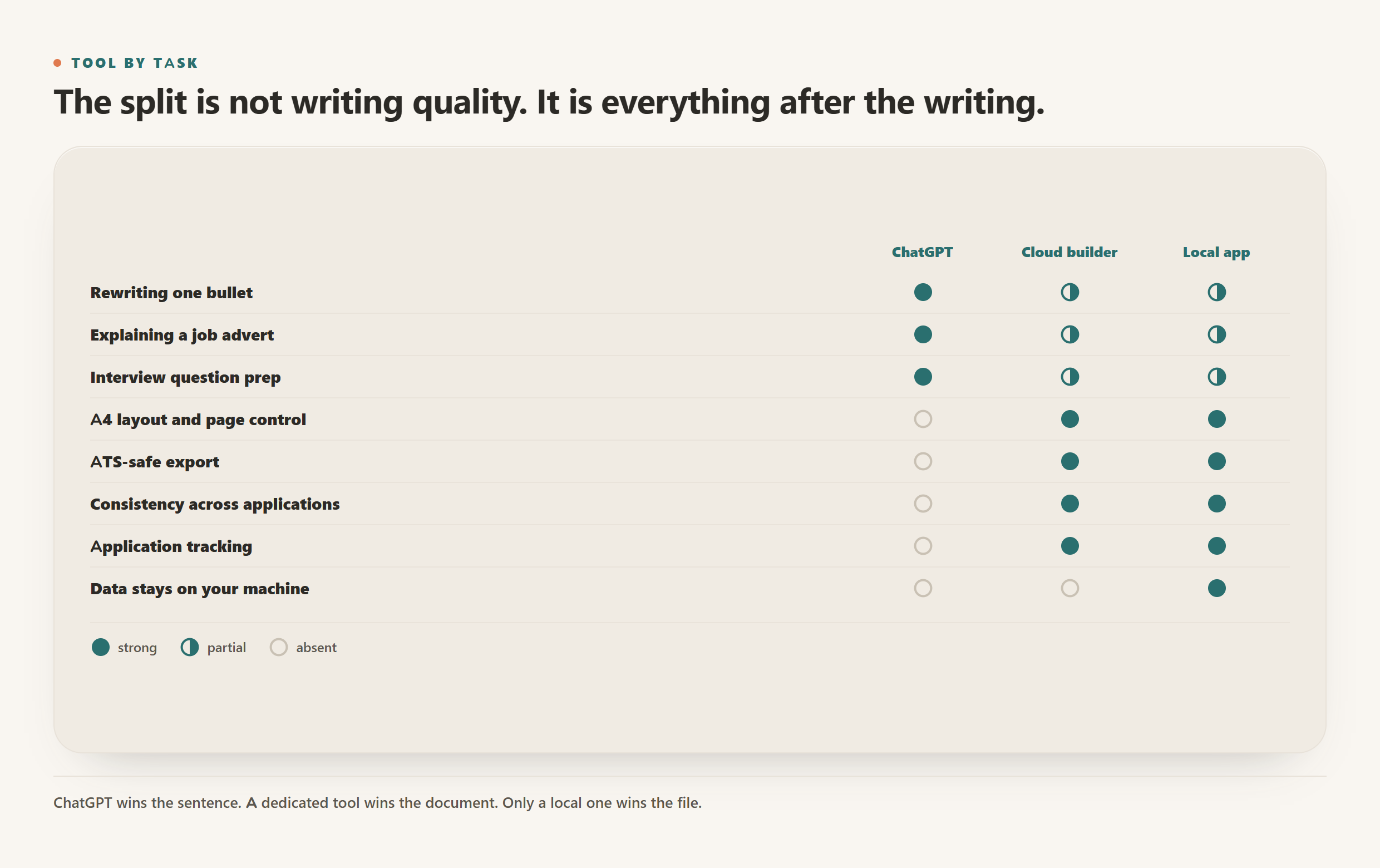
The three-way split
| What you need | Best tool | Why |
|---|---|---|
| Sharpen one sentence | ChatGPT | Free, fast, and no CV needs to be uploaded for it |
| Understand a job advert | ChatGPT | The advert is public, so there is no privacy cost |
| A formatted, ATS-safe PDF | A CV tool | A chat window cannot control an A4 page |
| Ten applications without drift | A CV tool | Consistency needs a stored master profile |
| Keeping your history off servers | A local CV app | The only option where the file never leaves your machine |
Where a local app lands
A desktop tool is the combination most people do not know exists: the writing quality of a current model, the layout and consistency of a dedicated builder, and none of the storage.
CVumi is built this way. It keeps one master profile on your computer, tailors a CV, a matching cover letter and a covering email to each specific job advert, exports both a designed PDF and an ATS-safe version, and files every application so you can see what you sent and when. The AI step runs through your own API key, so your text goes to the model provider under API terms and never through a CVumi database. There is no CVumi server holding your documents.
It also refuses to invent things. The tailoring works from what is actually in your profile, and the fit analysis is explicit about the gaps rather than papering over them. That constraint is the point: a CV you cannot defend in an interview is worse than a plain one.
It is a one-time payment: 69 EUR for a standard licence covering three devices, or 34 EUR with a student email. Windows today, macOS soon.
How to decide
Ask one question: is this a sentence problem or a document problem?
A sentence problem is "this bullet is weak" or "what does this job title mean". Use ChatGPT, it is free and it is good at exactly this.
A document problem is "I need a properly formatted CV, tailored to this specific advert, consistent with the nine I already sent, that survives an ATS parser and that I can find again next month". That is not a chat problem, and no amount of prompting turns it into one.
Most job searches are both. Using the free tool for the first and a real tool for the second is not a compromise, it is just the correct allocation.
If you want to see the tailoring side in practice, read how to tailor a CV to a job description without uploading it to the cloud.