are AI CV builders safe
Are AI CV builders safe? What they actually do with your data
Some AI CV builders keep your data private; others store it indefinitely, feed it to a model, or pass it to partners. Here is what actually happens to your CV, and how to check any tool before you trust it.
Your CV is the most concentrated personal file you own. It holds your full name, where you live, how to reach you, every employer, every date, and often your photo or date of birth. An AI CV builder needs that file to do its job. So the safety question is not whether the tool writes well. It is what the tool does with the file once you hand it over.
The honest answer to "are AI CV builders safe" is that it depends on the tool, and the gap between them is wide. Some keep nothing. Others keep a copy on their servers indefinitely, feed your text to a model, or pass it to partners you never chose. This guide covers the three things a cloud builder can do with your data, how to check any tool in a few minutes, and why running the work on your own machine changes the picture.
What "safe" actually means for a CV builder
Safe is not a badge a tool earns once. It is the sum of a few concrete answers. A builder is only as safe as your ability to say where your file lives, whether it can train a model, who else can read it, and whether you can truly delete it. A tool with excellent AI can still be a poor choice if the file ends up in a database you cannot see into.
Start with what is at stake. A CV is a compact identity kit: name, address, phone, email, work history, and sometimes a date of birth or a photo. That is most of what someone needs to impersonate you or build a convincing scam aimed at you. The bar for handing it over should be higher than for a photo editor or a note app, not lower because the tool feels useful.
The three things a cloud CV tool can do with your data
When you paste or upload your CV into a hosted builder, three things can happen to it. Not every tool does all three, and the honest ones tell you which apply. The trouble is that the defaults often run against you, and the wording is easy to skim past.
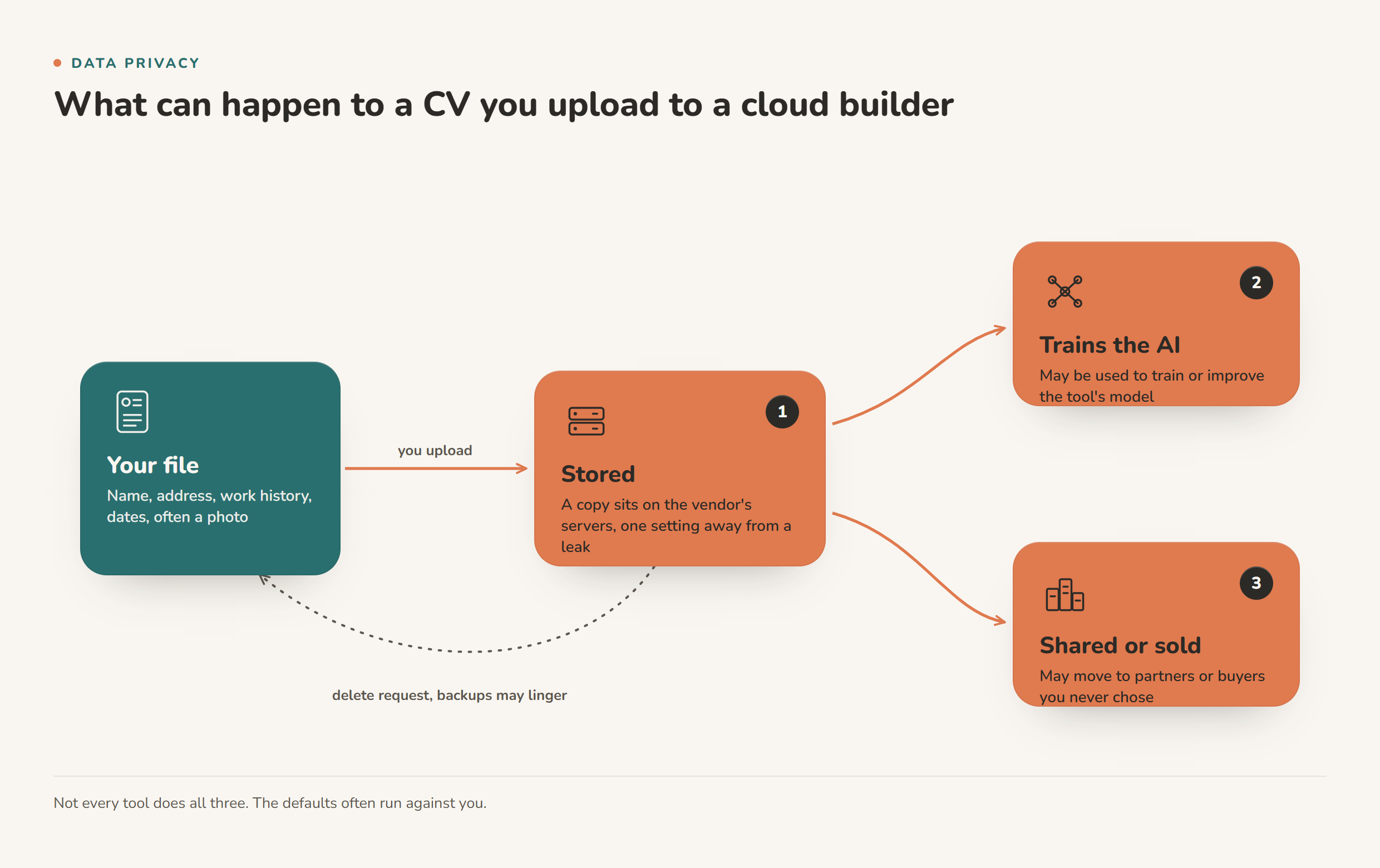
It stores your file, and storage is the risk
A hosted builder keeps a copy of your CV. That is the product, not a side effect: the file has to sit on a server so you can edit it from any device. The catch is that a stored copy is a copy that can leak.
This is not hypothetical. In 2025, the resume site LiveCareer left a cloud storage container exposed with no authentication, spilling roughly 5.1 million files, mostly resumes and CVs dating back to 2016. The exposed data included full names, phone numbers, email addresses, home addresses and detailed work histories (Cybernews). Nobody had to break in through a firewall. One misconfigured container was enough. Every stored copy of your CV is one setting away from that outcome.
The takeaway is plain. The safest copy of your CV is the one that never left your machine, because a file that was never stored cannot be spilled.
It may use your data to improve its AI
Most AI CV builders run on a large language model, and that layer raises a second question: does your text get used to train it?
The distinction that matters is between a consumer chatbot and a business API. If a tool routes your CV through a consumer chat product, the text can be stored and used to train the model, depending on the plan. The business APIs behind most serious tools are stricter by default. Anthropic states it plainly: "By default, we will not use your inputs or outputs from our commercial products (e.g. Claude for Work, Anthropic API, Claude Gov, etc.) to train our models" (Anthropic). OpenAI says the same for its API, where data has not been used to train models by default since March 2023, with abuse-monitoring logs kept for up to 30 days (OpenAI).
So the model provider is often not the weak point. The builder in the middle can be. A tool can still hold your CV in its own database and reserve the right to use it to "improve our services", whatever model sits behind it. That clause is the one to find.
It may share or sell your data
The third thing is the one tools talk about least. Read a privacy policy for "partners", "affiliates" and "service providers", and you often find your data can move to companies you never picked. Career data has a market, because recruiters, employers and background-screening firms will pay for profiles of candidates.
Regulators have acted on this before. In 2012 the data broker Spokeo paid 800,000 USD to settle FTC charges that it compiled personal profiles and sold them to the human resources, background-screening and recruiting industries without the protections the Fair Credit Reporting Act requires (Federal Trade Commission). The case is old, but the business model behind it is not. If a tool is free and never explains how it earns money, treat the data itself as part of the price.
How the three main designs compare
AI CV builders do not all handle data the same way. Broadly there are three designs, and they sit at very different points on the safety scale.
| Data question | Typical cloud builder | Bring-your-own-key builder | Local desktop app |
|---|---|---|---|
| Where your CV lives | On the vendor's servers | Mostly on your device, sent per request | In a folder you choose on your machine |
| Can it train a model? | Sometimes, check the terms | Only if the AI provider does, which the API usually does not | Same, depends on the provider, not stored by the app |
| Can it be shared or sold? | Possible through "partners" clauses | Little to share, the vendor holds no copy | Nothing to share, the vendor never sees it |
| What a vendor breach exposes | Your stored CV and account data | Little, there is no CV database | Nothing, there is no vendor database |
| Can you truly delete it? | A delete request, backups may linger | Mostly nothing to delete | The file is yours to remove anytime |
The pattern is clear. The more of the work that happens on your own device, the less there is to store, train on, share, or leak. For a fuller rundown of specific tools that follow the private designs, see the best privacy-friendly AI CV builders in 2026. If your bar is that nothing may ever leave the laptop, local and offline AI resume tools compared covers the strictest end of the scale.
How to check whether a builder is safe, in a few minutes
You do not need a security background to vet a tool. Open its privacy policy and terms, use the search box, and check four things.
- Storage and deletion. Search "store", "retain" and "delete". Find how long uploads are kept and whether deletion also clears backups. A specific number of days beats a vague promise.
- Training and improvement. Search "train", "improve our models" and "improve our services". If your content can feed a model or the product, the policy should say so. For a bring-your-own-key tool, read the AI provider's policy too, because that is where your text actually goes.
- Sharing and selling. Search "third parties", "partners", "sell" and "share". In some regions "share" carries a legal meaning close to "sell", so read both words.
- The price of free. If a free tool never explains how it makes money, assume your data is part of the answer.
There is a legal backstop if a copy does get out. In the EU, the right to erasure lets you ask a company to delete your personal data (GDPR Article 17). It is worth using, though it has limits: backups and data already shared can linger, and asking for deletion after the fact is always weaker than never sending the file. For the whole-search version of this, from what to leave off the page to the hidden metadata inside the file, see how to keep your career documents fully private.
The safer default: keep the file on your machine
The cleanest way to answer every question above is to not create the risk in the first place. If the tool runs on your own computer, there is no vendor database to store your CV, train on it, share it, or lose it in a breach.
That is how CVumi is built. It is a desktop app for Windows and macOS. Your CV, your master profile and your past applications live in a folder you pick on your own machine. There is no CVumi server holding your documents, and the company never sees them. You do not need an account to use it; an email address is required only at purchase.
When an AI step runs, the request goes straight from your computer to your chosen AI provider under your own API key, not through a CVumi database that keeps a copy. So the chain stays short: your file on your disk, one request under your key, and a provider that does not fold that request into its training set by default.
The tailoring is still done for you. From your history and a job description, CVumi writes a tailored CV, a matching cover letter and a covering email in one pass. Its fit analysis shows where you genuinely match a role and where the real gaps are, using only your actual experience, and it does not invent achievements to fill a blank. When the application is ready, one click opens your normal email client with the CV and cover letter attached, so you review and send it yourself. Nothing goes out on your behalf.
One honest point. CVumi is local, not fully offline: the AI steps need a connection. The difference from a cloud builder is that your documents are never parked on a server to be stored and reused. On cost, it is a one-time payment: 69 EUR for the standard licence with three device activations, or 34 EUR with a student email. No subscription, and no per-application credit.
The short version
Are AI CV builders safe? Some are, and some quietly store, train on, or pass along the most sensitive file you own. The way to tell is to ask three questions of any tool: where does my CV live, can it train a model, and who else can read it. The safest answers all point the same direction, toward keeping the file on your own machine.
If you would rather not read a privacy policy every time you apply, you can skip the question entirely. Download CVumi and your CV, cover letter and email are built on your own computer, under your own key, in a folder only you can open. One payment, no subscription, and nothing left on a stranger's server for you to chase down later.